
AI Bias Mitigation in Pricing Systems: Detecting and Preventing Unfair Algorithms
AI algorithms now influence critical business decisions, from determining creditworthiness to optimizing prices across customer segments. Biases in AI systems can lead to systematic and unfair outcomes, and AI bias mitigation has become essential for businesses seeking both profitability and fairness. Pricing algorithms trained on data reflecting historical patterns of inequality can discriminate without anyone noticing. The business costs include regulatory fines and brand damage. This piece explores algorithmic bias in pricing systems and provides proven strategies for bias detection and mitigation in AI to ensure your pricing models deliver fair, profitable outcomes.
Understanding Algorithmic Bias in Pricing Systems
What Is Algorithmic Bias in Pricing
Algorithmic bias occurs when machine learning models produce unfair or discriminatory outcomes that put specific customer groups at a disadvantage. Your algorithm assigns different prices to customers based on patterns that reflect or increase historical inequalities related to race, gender, geography, or socioeconomic status. The difference matters: bias represents a deviation from standard practices, but it doesn’t constitute discrimination automatically. Pricing algorithms learn from data containing prejudiced assumptions or non-representative training sets. That bias transforms into discriminatory pricing that harms both customers and your business reputation.
The problem extends beyond simple technical errors. Algorithmic bias in pricing emerges through multiple pathways. Your training data reflects societal inequalities already present in the market, and this creates historical bias. Representation bias occurs when datasets lack geographical or demographic diversity. Measurement bias happens through how you select and analyze specific customer features. These biases compound when algorithms process data. The result is pricing disparities that appear objective but overcharge vulnerable populations systematically.
Why Pricing Algorithms Are Prone to Bias
Pricing algorithms face three main vulnerability points: input bias, training bias, and programming bias. Your data is non-representative, incomplete, or reflects historical discrimination patterns, and this creates input bias. Algorithms preserve and propagate these imbalances through their outputs rather than correcting them. Training bias arises when learning algorithms mistake correlation for causation and lack the contextual understanding to distinguish between the two. Your algorithm cannot determine when additional data might be required to produce accurate results genuinely.
Programming bias describes the subjective rules and design choices embedded in your algorithm’s architecture. These decisions can increase inequality through feature selection and proxy variables, whether conscious or unconscious. Take the case of algorithms that optimize for profit maximization without fairness constraints. They excel at identifying customers willing to pay premium prices and then charge those prices regardless of whether the pattern exploits systemic disadvantages. Feedback loops in dynamic pricing create self-reinforcing cycles where biased outputs influence future training data and worsen discrimination over time progressively.
The quality of your collected data influences algorithmic decisions directly. Your outcomes will follow suit if your dataset contains prejudicial bias unless you implement appropriate controls. The trade-off between accuracy, fairness, and privacy requires constant evaluation. Your algorithm’s effectiveness relies on data quality, yet that same data often carries embedded biases that your model will learn and replicate without intervention.
Ground Impact on Business and Customers
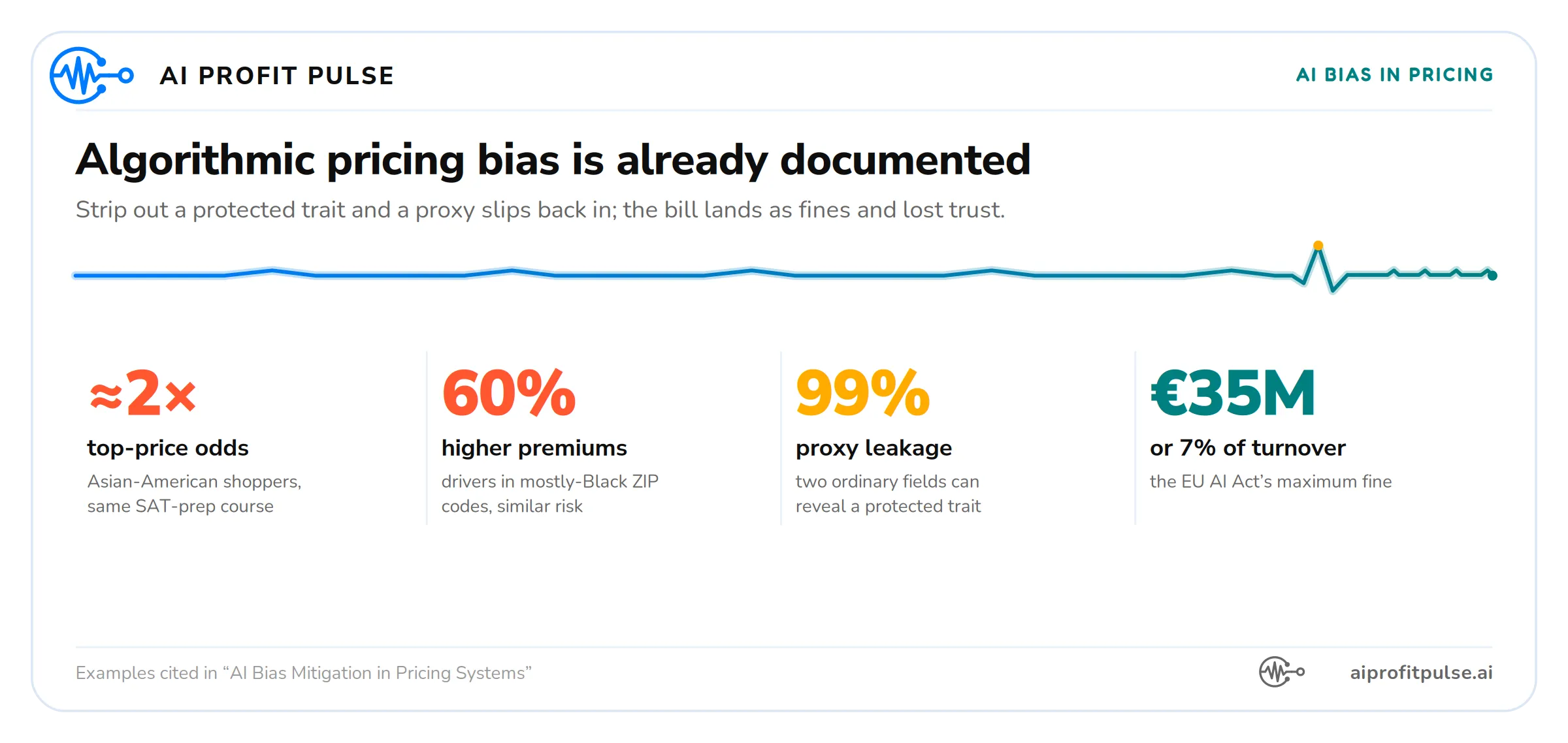
The consequences of biased pricing algorithms extend far beyond theoretical concerns. A University of California, Berkeley study revealed that AI mortgage systems charged minority borrowers higher rates for similar loans compared to white borrowers routinely. Researchers found that Uber and Lyft’s pricing algorithms charged more for drop-offs in neighborhoods with high non-white populations after Chicago mandated ride-hailing fare disclosure. The Princeton Review’s pricing algorithm charged between $6,600 and $8,400 for similar SAT prep courses, with Asian-American customers nearly twice as likely to receive the highest prices. Insurance algorithms in California, Illinois, Texas, and Missouri charged drivers in predominantly Black ZIP codes premiums 60% higher than White neighborhoods despite similar accident risk profiles.
These algorithmic bias examples create severe business risks. Consumers from marginalized groups avoid companies using pricing algorithms when they believe discriminatory outcomes are likely actively. Customers view your prices as unfair fundamentally when they perceive or observe that others pay different amounts for similar products. This perception persists even when price variations don’t violate existing laws. Algorithmic price discrimination triggers feelings of betrayal, especially when loyal customers pay more than new ones.
Regulatory scrutiny intensifies as enforcement agencies prioritize algorithmic pricing investigations. The FTC has opened probes into AI-driven tools that generate different prices for different customers. California’s Attorney General launched investigations into how businesses use personal data for targeted pricing. Colorado mandated that AI developers protect consumers from foreseeable risks of algorithmic discrimination. Non-compliance with regulations like the EU AI Act can result in fines up to €35,000,000 or 7% of worldwide annual turnover.
Biased algorithms erode customer trust in your digital marketplace beyond regulatory penalties. Consumers lose confidence in AI as a tool for fair commerce when they experience unfair outcomes repeatedly. Your pricing system’s perceived fairness affects customer retention, brand reputation, and long-term profitability directly.
Common Types of Biases in AI Systems for Pricing
Geographic and Regional Pricing Bias
Pricing algorithms frequently assign costs based on customer location and create systematic disparities between regions and neighborhoods. Staples designed an online pricing algorithm that charged higher prices in lower-income neighborhoods and lower prices in higher-income areas back in 2012. The reason wasn’t that lower-income consumers had greater purchasing power but that their neighborhoods had fewer retail competitors. Researchers found that there was a pattern where Uber and Lyft’s algorithms charged higher prices for rides to and from low-income neighborhoods in Chicago, likely driven by driver behavior and surge pricing as drivers avoided these areas. Uber’s system calculates riders’ propensity for paying higher prices based on route characteristics and charges premium rates when someone travels from one wealthy neighborhood to another tony spot, even when demand, traffic, and distance remain similar to routes ending in lower-income areas.
Price discrimination at the regional level extends beyond neighborhood-level variations. SaaS companies routinely charge different prices across countries, with subscriptions costing $50 monthly in the United States but only $25 in India or Brazil. Spotify’s premium service costs approximately $9.99 in the US but $2.50 in India. Companies justify these differences as market adaptation that reflects GDP disparities, but the practice raises questions about when regional pricing crosses into unfair discrimination.
Demographic-Based Price Discrimination
Algorithms systematically charge different prices to customers based on demographic characteristics, often without explicit programming to do so. The Princeton Review’s pricing algorithm charged between $6,600 and $8,400 for similar SAT prep courses, with customers in predominantly Asian neighborhoods nearly twice as likely to receive the highest prices compared to the general population, even in low-income areas. Insurance algorithms in California, Illinois, Texas, and Missouri charged drivers in predominantly Black ZIP codes premiums 60% higher than White neighborhoods despite nearly similar accident risk profiles. Research on Allstate’s price-adjustment algorithm in Maryland revealed optimization that was designed to charge “big spenders” more for car insurance.
Mortgage lending algorithms showed similar patterns and charged higher rates to Black and Latine applicants even when they were risk-equivalent to non-minority applicants. Uber and Lyft’s systems charged higher prices to women than men for comparable rides. Yes, demographic price discrimination remains widespread because consumers view algorithmically determined prices as more fair than human-set prices and feel less judged by automated systems. This perception enables discriminatory outcomes to persist with less consumer backlash.
Historical Data Bias in Price Optimization
AI pricing algorithms inherit and increase biases embedded in their training data. When systems learn from historical transaction data that reflects past discriminatory patterns, they perpetuate those inequalities into future decisions. Training datasets often encode societal biases, historical inequalities, or systemic injustices present during data collection. Historic discrimination like redlining, where financial services were denied based on race, appears in AI model training data for bank loan decisions and causes systems to unfairly penalize individuals who share socioeconomic characteristics with past redlining victims.
Historical bias extends beyond financial services. The complexity emerges because training data reflects how markets operated, not how they should operate. Your algorithm cannot distinguish between patterns that reflect genuine priorities versus patterns that reflect historical prejudice unless you intervene.
Temporal Bias in Dynamic Pricing Models
Dynamic pricing algorithms adjust costs based on time-dependent factors and create temporal biases that affect different customer groups unequally. These systems update prices that respond to residual demand, decreasing prices when quantity demanded falls too low and increasing them when demand rises. Consumers can substitute across periods with minimal cost and time purchases to avoid high-price periods. Uber received substantial backlash for maintaining surge pricing after London terrorist attacks in 2017, when demand skyrocketed and prices multiplied several times above normal rates. Time-based discrimination operates differently than demographic discrimination, as algorithms set prices based on when transactions occur rather than who initiates them.
How Bias Enters Pricing Algorithms
Training Data Issues and Incomplete Customer Profiles
Bias infiltrates pricing algorithms through the quality and completeness of your training data. Your AI performs only as well as the data feeding it. Incomplete customer profiles create blind spots that skew algorithmic decisions in predictable ways. Missing firmographic details, outdated contact information, or unknown technology stacks generate three critical problems: false negatives where high-potential customers receive low scores due to missing data and slip through unnoticed; false positives where partially qualified accounts get over-prioritized based on incomplete information and waste resources; and bias increase where inconsistent or erroneous data skews model training and distorts future predictions.
Your model can make apples-to-apples comparisons across your entire customer base with complete profiles. Without them, your algorithm cannot achieve an objective view of opportunities. Bad data proves worse than missing data. Your pricing strategy gets built on unstable ground when your CRM or data providers feed AI with outdated, duplicated, or incorrect information. AI models learn from true historical outcomes with accurate profiles, scoring aligns with real buying patterns, and teams trust the outputs.
Feature Selection and Proxy Variables
Excluding protected attributes like race or gender from your algorithm doesn’t prevent discrimination. This approach, called fairness-through-unawareness, fails because other input features act as effective proxies for what you attempted to hide. Combinations of seemingly innocuous features can predict protected characteristics with near certainty even when your model doesn’t know about them.
Occupation and marital status combinations create powerful proxies for gender. Individuals are male 99% of the time when occupation equals “Repair” and marital status equals “Married,” with this combination representing 8% of datasets. Marital status “Widowed” predicts female gender due to the gendered nature of the term itself. Machine learning algorithms possess inherent tendencies to involve in proxy discrimination when deprived of directly predictive traits. Predictive AIs locate correlations between input data and target variables without relying on causal explanations. AIs seek out proxies for directly predictive characteristics when data on these characteristics isn’t available due to legal prohibitions. Denying AIs access to intuitive proxies causes them to produce models relying on less obvious proxies.
Algorithmic proxy discrimination exerts disparate impacts on protected groups because algorithms adopt facially neutral proxies through their operational logic. The abundance and complexity of proxy relations in big data render discrimination inescapable and difficult to identify.
Algorithm Design Choices That Increase Inequality
Platform-based pricing systems introduce acute informational asymmetry between platforms and sellers. Sellers receive coarse information about potential consumers through monitoring their own transactions. Platforms generate detailed data about consumer characteristics. Price recommendation algorithms utilize this private information to affect seller behavior. Platforms increase revenue under informative price recommendation systems while consumer surplus decreases by more than 30%. These systems nearly double consumer surplus losses by increasing the extent to which algorithmic pricing guides to supra-competitive prices.
The platform’s optimization problem creates tension between precision and fairness. Sellers can target prices with more precise recommendations, raising them in high-demand states and decreasing them in low-demand states. This precision increases inequality as algorithms pool recommendations across demand states in ways that disadvantage certain customer segments.
Feedback Loops in Dynamic Pricing
Dynamic pricing creates self-reinforcing cycles where today’s biased outputs become tomorrow’s training data. Consumer feedback influences sellers’ pricing decisions. The algorithm interprets reduced demand as lower price sensitivity when it charges higher prices to specific demographic groups and those groups reduce purchases. So it maintains or increases prices for those groups in future iterations. This feedback loop worsens discrimination over time and embeds bias deeper into your pricing model with each cycle. Biased pricing patterns perpetuate indefinitely given that algorithms learn from historical outcomes unless you intervene with fairness constraints and regular auditing protocols.
Detecting Bias in Pricing Systems
Statistical Methods for Bias Detection and Mitigation in AI
Statistical fairness metrics provide structured frameworks to calculate bias in your pricing algorithms. Demographic parity examines whether all demographic groups receive favorable outcomes at equal rates and ensures approval rates remain consistent across protected groups. Equalized odds takes a more nuanced approach. It requires both false positive and false negative rates to stay equal across customer segments. Disparate impact analysis examines the ratio of favorable outcomes between groups and originates from legal frameworks. Your model may violate regulatory standards if one demographic receives fewer favorable outcomes by a lot (below 80% of the advantaged group’s rate).
Clustering techniques identify groups where your algorithm performs differently and indicate potential unfair treatment. These anomaly detection methods group data points that are similar together. They then highlight clusters with the worst bias variables through statistical hypothesis testing. One-sided Z-tests compare bias variable means between the most deviating cluster and your remaining dataset. You examine feature differences to pinpoint root causes when testing reveals differences that are statistically significant.
Explainability tools like SHAP (SHapley Additive Explanations) reveal which features influence pricing decisions more than others and expose hidden biases in your model’s decision-making logic. These interpretability techniques transform abstract fairness metrics into compliance signals you can act on.
Testing Pricing Outcomes Across Customer Segments
A/B testing allows you to compare AI outcomes for different demographic groups before full deployment. You build test cases that represent various customer segments and edge cases. You also include scenarios that are potentially problematic. This stress-testing approach uncovers biases that statistical measures alone might miss. Diverse test set creation should include both visible demographics and less obvious attributes like socioeconomic status or language patterns.
Regular audits provide quality assurance layers to maintain fairness over time. Annual deep-dive audits examine your overall pricing structure, tiers and market positioning. Quarterly or monthly metric checks track conversion rates and discounting trends across segments. You catch emerging discrimination before it causes harm if you conduct these reviews in a systematic way.
Monitoring Price Disparities in Real-Time
Point-in-time bias testing represents a reactive approach that remains behind emerging harm. Production systems are dynamic, not fixed. Bias emerges and grows in live environments through data drift, where inference data diverges from training data. A loan approval model might perform equitably until economic shifts change applicant financial profiles and introduce skew within weeks rather than years.
Up-to-the-minute monitoring provides continuous tracking of pricing outcomes across customer segments. Automated systems flag breaches earlier and document disparities. They enable responses before discriminatory patterns spread. You set alerts that trigger when key SKUs fall outside defined pricing thresholds and reduce response time from days to minutes. This continuous health monitoring tracks bias, drift and performance at the same time. It treats fairness as an always-on observability challenge.
Red Flags and Warning Signs of Unfair Pricing
EU competition enforcers identified specific red flags during large-scale algorithmic pricing reviews. These include anomalous pricing contact patterns that suggest indirect collusion. Algorithms remove normal price competition from well-functioning markets when they help contacts between competitors or coordinate rates without explicit agreements. Therefore, regulators now examine whether pricing algorithms serve as means for tacit collusion.
Price disparities that correlate strongly with protected characteristics signal potential discrimination. Your algorithm warrants immediate investigation when similar products cost different amounts across ZIP codes with varying racial compositions. Loyal customers who pay more than new customers for similar services indicate algorithmic price discrimination that consumers see as betrayal.
Proven Strategies for Mitigating Bias in Pricing Algorithms
Building Representative Training Datasets
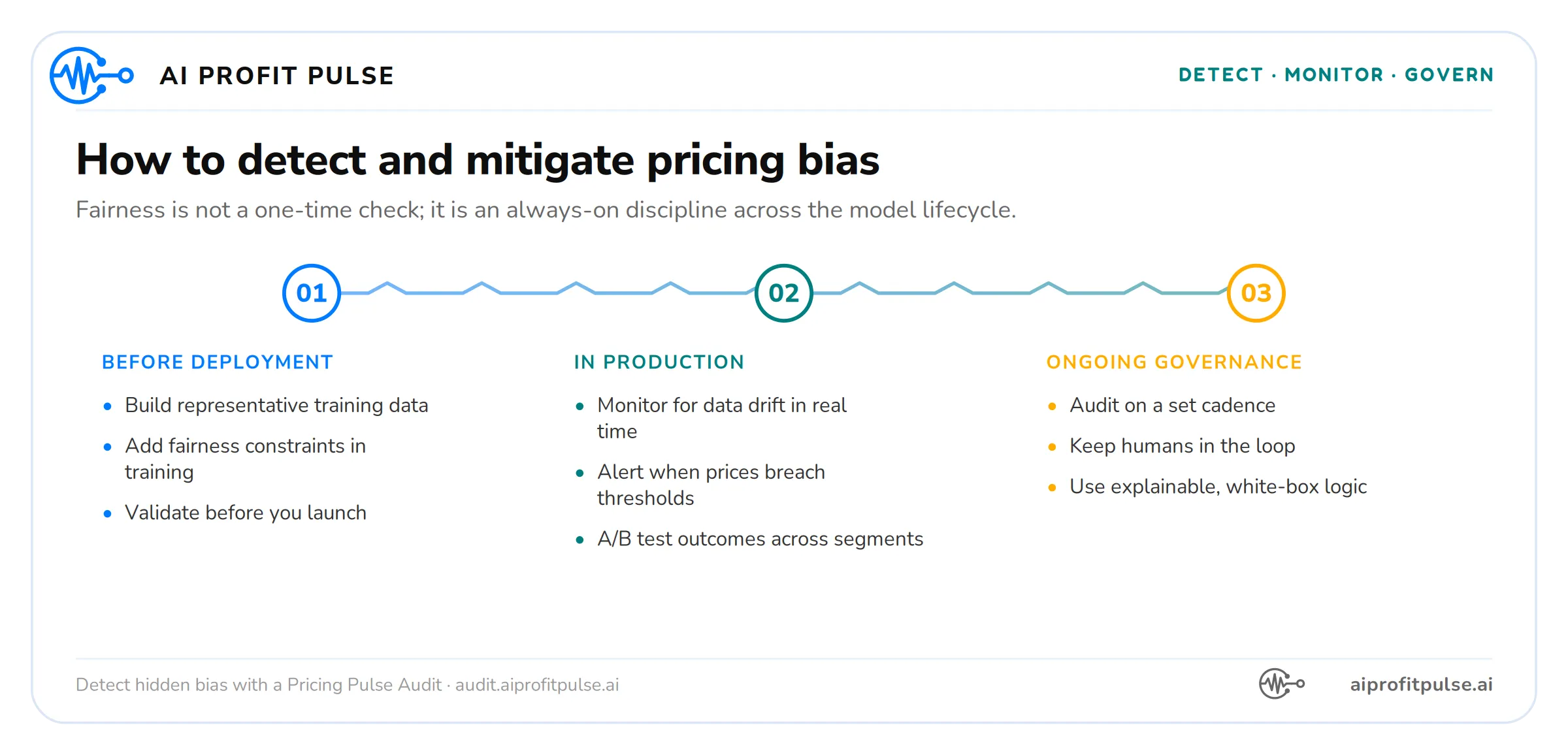
Diverse training data improves AI accuracy, robustness and fairness. Your models learn to predict well when exposed to real-life variability across demographics, geographies and customer segments. Balanced datasets reduce bias and promote equitable outcomes. Therefore, you should collect data from multiple sources representing different regions, age groups, genders and ethnicities. Review datasets before deployment to ensure they don’t favor or exclude specific groups. A facial recognition system trained only on one region may fail for other ethnicities. Pricing models trained on limited customer segments produce inaccurate predictions for broader audiences in the same way.
Implementing Fairness Constraints in Price Models
Fairness constraints or additional optimization objectives modify your AI training process through in-processing techniques. These methods prevent algorithms from learning discriminatory patterns during training itself. Research demonstrates that fairness constraints in dynamic pricing achieve regret bounds while maintaining price equity across customer groups. You can implement demographic parity constraints that ensure outcomes distribute equally. You can also use equalized odds constraints requiring consistent false positive and false negative rates across segments. Your fairness definition matters substantially, as price fairness, demand fairness and surplus fairness each produce different welfare outcomes.
Regular Auditing and Bias Testing Protocols
Bias testing must occur throughout your AI lifecycle: before deployment, during deployment and after deployment. Pre-deployment validation catches structural issues, real-time monitoring detects emerging problems and post-market surveillance addresses performance degradation. Businesses should perform regular audits of pricing software and create safeguards that protect commercially sensitive data. Monitor your algorithmic tools periodically to assess performance and identify discriminatory patterns with collateral damage.
Human Oversight and Review Processes
Human-in-the-loop approaches help identify and reduce bias embedded in data and algorithms. Humans who approve or override AI outputs give you ethical reasoning capabilities beyond model limitations. This oversight creates audit trails that support transparency and accountability. Managers implementing algorithmic pricing emphasize keeping humans in the loop as critical to maintain control over pricing decisions.
Transparency in Pricing Algorithm Operations
Explainable AI promotes end user trust, model auditability and productive AI use while reducing compliance and reputational risks. White box algorithms that are explainable, combined with oversight mechanisms that detect bias, represent industry best practices. Subscribe to receive weekly strategies that keep you ahead of market dynamics for ongoing insights onpricing experimentation and revenue optimization tactics.
Building a Fair Pricing Framework
Establishing Ethical Guidelines for Pricing AI
Fairness in pricing proves subjective and depends on what you measure. Two common types include price fairness, which will give similar prices for similar products across different groups, and access fairness, which focuses on affordability rates across customer segments. Balancing fairness rather than enforcing perfection guides to better outcomes for consumers and businesses. Forcing strict fairness can backfire. Banks stopped lending to higher-risk areas after regulators required similar interest rates.
Cross-Functional Team Approach to Pricing Systems
Addressing algorithmic bias requires interdisciplinary collaboration spanning engineering, law, operations research, public policy and economics. Cross-functional teams challenge assumptions and curb groupthink more effectively than homogeneous groups. Diverse teams act as safeguards against building biased systems. About 75% of cross-functional teams are dysfunctional due to competing priorities or unclear missions.
Compliance with Anti-Discrimination Regulations
The Robinson-Patman Act prohibits price discrimination that lessens competition or creates monopolies in interstate commerce. New York’s Algorithmic Pricing Disclosure Act requires businesses to disclose when algorithms use personal data for pricing. California’s AB 325 prohibits common pricing algorithms that ingest competitor data.
Continuous Monitoring and Model Updates
Continuous monitoring treats fairness as an always-on observability challenge and catches model drift as input data evolves. Subscribe to receive weekly strategies for ongoing insights onpricing experimentation and revenue optimization tactics that help you retain your competitive edge.
Conclusion
Bias mitigation in pricing algorithms protects both your customers and your bottom line. We examined how bias enters pricing systems through training data and design choices in this piece, then explored proven detection methods including statistical analysis and up-to-the-minute monitoring. Building representative datasets and establishing continuous auditing protocols will give your pricing equitable outcomes while maximizing profitability. Regulatory scrutiny intensifies as enforcement agencies prioritize algorithmic fairness. This makes bias mitigation essential rather than optional. Ready to ensure your pricing algorithms generate profit without discrimination? Schedule your Pricing Pulse Audit today to identify hidden biases and tap into sustainable revenue growth through fair, optimized pricing strategies.