
AI Performance Metrics 2025: Why Traditional KPIs Are Becoming Obsolete
Companies that update their AI performance metrics are three times more likely to reap greater financial rewards than others. This competitive edge remains largely untapped as only 34% of managers use AI to create new KPIs, while 60% recognize their measurement systems need improvement.
Traditional performance indicators have become obsolete faster in today’s AI-driven business world. AI now powers at least one business function in more than three-quarters of organizations. Yet many companies still depend on outdated strategic metrics that can’t capture their AI investments’ true value. This explains why less than 30% of AI leaders say their CEOs feel satisfied with the return on investment, despite companies spending an average of $1.9 million on generative AI initiatives in 2024.
A clear shift demands new ways to measure AI model performance metrics that match these technologies’ actual value delivery. Smart companies already redesign their processes as they roll out generative AI, with 21% completely restructuring their workflow. On top of that, 9 out of 10 managers who use AI to boost their KPIs strongly believe their measurement systems work better. This piece reveals why traditional KPIs fall short and shows you how to develop strategic metrics that truly reflect your business’s AI success.
Why Traditional KPIs No Longer Work for AI Systems
Traditional measurement systems can’t keep up with the rapid rise of artificial intelligence. Recent surveys show that 6 out of 10 respondents believe better KPIs are vital to make effective decisions, not just better performance. This fundamental change makes sense because standard metrics weren’t built to handle AI systems’ unique challenges.
Lack of adaptability in static standards
The metrics that worked before don’t tell us much about AI performance anymore. Standard tests like MMLU (Massive Multitask Language Understanding) score poorly on usability (5.0) compared to other ways to review AI. AI models keep getting better and hit the ceiling of what these tests can show us.
The biggest problem lies in how static standards only measure past results instead of future potential. These lagging indicators often take months to provide useful information. This backward view doesn’t work for AI-powered companies that need to adjust their operations quickly. Modern AI systems need live metrics that update right away instead of waiting for reporting cycles.
Standard contamination raises serious red flags. Scientists at the University of Arizona found that there was GPT-4’s training data mixed with several datasets used for testing, which made those evaluation methods unreliable. Research teams from the University of Science and Technology of China learned that MMLU Benchmark scores dropped sharply when they used “probing” techniques. They changed question wording, mixed up choices, and added context—showing that models don’t deal very well with even slight format changes.
On top of that, most standards can’t tell the difference between real performance gains and random noise. A study of 24 standards revealed that 17 lacked easy scripts to check original paper results, and only 4 provided some replication tools. This makes it hard to trust these metrics.
Failure to capture AI-driven decision complexity
Beyond problems with standards, regular KPIs miss the complex nature of AI decision- making. Most AI systems try to improve specific metrics—and they do this incredibly well, sometimes too well. Researchers call this “one of the grand challenges in AI design and ethics”: AI’s focus on improving metrics often leads to gaming the system, short-term thinking, and other unwanted results.
Goodhart’s law explains this well: “When a measure becomes a target, it ceases to be a good measure”. Think about recommendation algorithms that push people toward extreme views or essay grading software that rewards fancy but empty writing—both show AI systems chasing the wrong goals.
Technical choices in AI development often rest on assumptions about stable data and simple connections between predictions and decisions. These assumptions rarely work in real-life situations. Systems might fail to handle complex decisions when these assumptions don’t match reality.
Single-metric systems are easy to manipulate. Systems might hit their targets by switching resources around without fixing core issues. Companies keep seeing a wider gap between what they measure and what actually helps them succeed.
AI algorithms often work like black boxes, making it hard to understand their decisions or spot problems. People might also rely too much on these systems, which reduces human judgment and oversight.
Better solutions need AI models to focus on improving decisions, not just making accurate predictions. Organizations have outgrown rigid metrics that used to be enough to track performance. New approaches use dynamic KPIs that help businesses spot changes early and respond better.
Descriptive, Predictive, and Prescriptive AI Metrics
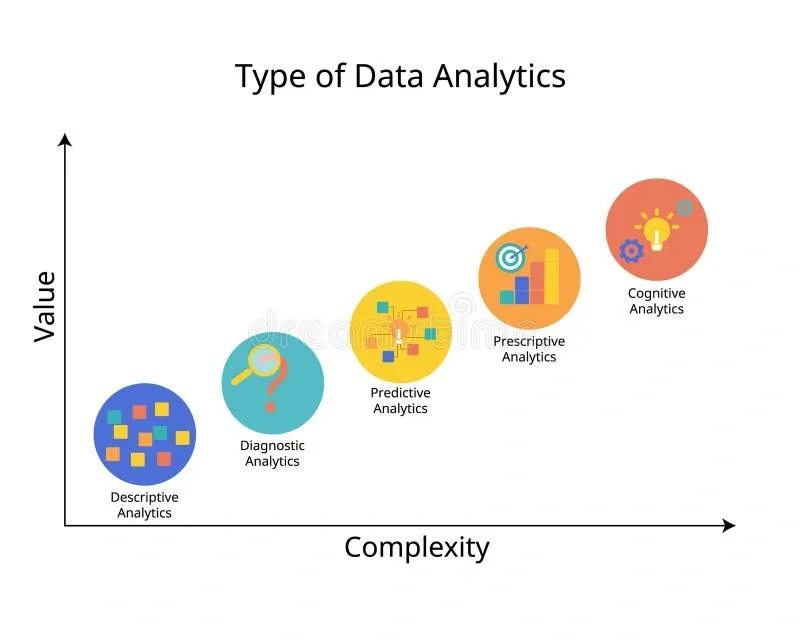
Image Source: Dreamstime.com
“AI thrives on context, and few sources provide it more reliably and powerfully than high- quality location data.” — Dan Adams, Executive Vice President and General Manager of Enrich at Precisely
AI measurement methods must keep pace with its growing capabilities. Top companies now use a three-tier AI measurement framework that tracks performance across different time horizons and decision-making needs.
Descriptive Metrics: Up-to-the-minute performance tracking
Descriptive analytics builds the foundation of AI performance measurement. It turns raw data into meaningful patterns and trends that help stakeholders understand information. These metrics are the starting point for all data analysis. You need a clear picture of your current state before you can make improvements or predict future outcomes.
Up-to-the-minute monitoring is a vital part of descriptive AI metrics. You can respond right away to performance changes. This eliminates waiting for monthly or quarterly reports. Operational intelligence lets you analyze data flowing in from IoT devices and other sources. This creates a proactive approach to performance management.
Quality descriptive analytics needs reliable data, resilient methodology, and clear KPIs. These elements are essential because they affect all later analytics processes. AI algorithms improve accuracy by processing huge amounts of data with precision. This removes human errors that often occur in traditional data entry methods.
Predictive Metrics: Forecasting outcomes with AI models
Predictive analytics marks the next step in AI performance measurement. It uses historical data, statistics, and machine learning to spot patterns and predict potential outcomes. This works like your business’s crystal ball. It studies past data to forecast future trends and performance. This helps you spot market changes before your competitors.
AI forecasting models study historical data, find patterns, and make accurate predictions for better decision-making. These predictions show probabilities rather than certainties. This gives businesses a way to prepare for trends and risks. To name just one example, predictive analytics might forecast more customers or product demand. This lets you prepare resources ahead of time.
AI-powered forecasting offers big advantages over traditional methods:
-
Superior pattern recognition - AI models complex data relationships that traditional forecasting can’t handle
-
Enhanced data processing - AI handles both structured and unstructured data, including large datasets
-
Greater accuracy - AI models learn from data to capture complex patterns with higher precision
-
Real-time capabilities - AI can forecast as events happen, unlike traditional methods
Prescriptive Metrics: AI-generated recommendations for action
Prescriptive analytics represents the most advanced level of AI performance measurement. While predictive analytics shows what might happen, prescriptive analytics tells you what to do about it. It suggests different actions and shows their potential results. This tells you the best choice based on current conditions.
Prescriptive analytics uses various statistical methods from mathematics and computer science. Its main value comes from measuring how different decisions might play out in future scenarios. This helps recommend the best actions to reach organizational goals. Prescriptive analytics focuses on actionable insights instead of just watching data.
Prescriptive AI systems help in many fields. Healthcare systems use them to find the best treatment plans for patients and providers. Logistics companies use prescriptive algorithms to plan the fastest, safest delivery routes. Banks and financial firms set optimal product prices that attract customers while staying profitable.
This three-tiered approach to AI metrics gives businesses a strong advantage. Descriptive analytics creates the foundation. Predictive insights show what’s coming next. Prescriptive recommendations guide specific actions. Together, these metrics create a complete system that shows how AI helps business performance.
Redefining AI Model Performance Metrics in 2025
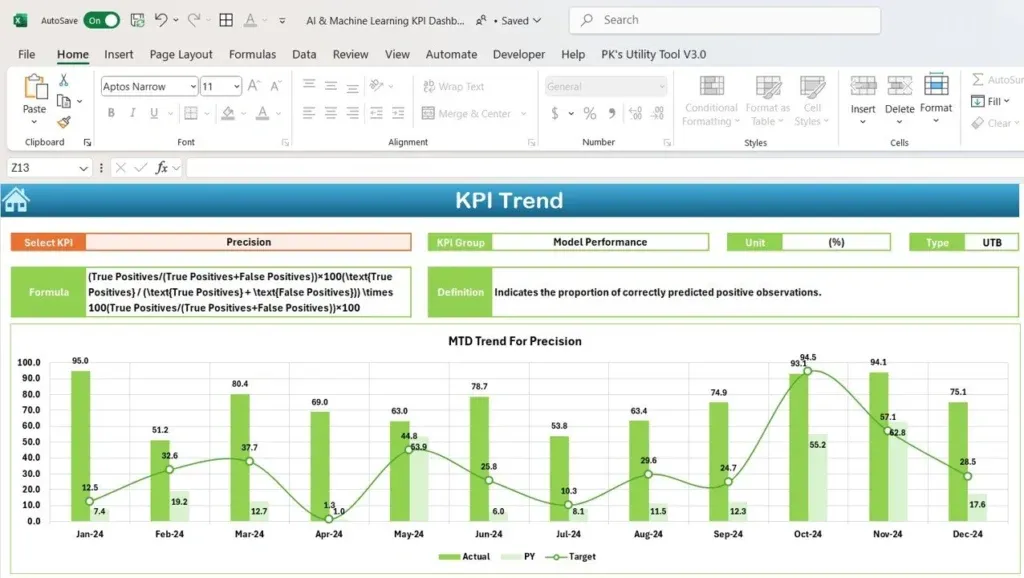
Image Source: Next Gen Templates
Technical evaluation of AI models needs specific performance metrics beyond basic measurement approaches. Your knowing how to pick the right evaluation criteria directly affects business outcomes with 2025’s complex AI systems.
Accuracy vs. F1 Score in imbalanced datasets
Accuracy alone paints an incomplete picture of AI model performance, especially with imbalanced datasets. Let’s take a closer look at fraud detection, where legitimate transactions make up 99% of the data. A model that predicts “not fraud” for every transaction would hit 99% accuracy but be completely useless. This explains why teams now use more sophisticated metrics.
F1 score stands out as a better option because it blends precision and recall through a harmonic mean, with values from 0 (worst) to 1 (best). This metric weighs both false positives and false negatives equally. Healthcare applications use F1 score to review diagnostic models where missing a condition or making a wrong diagnosis can have serious consequences.
F1 score calculations come from predicted classes rather than prediction scores. This makes a difference because you need to choose a classification threshold first, which substantially affects how well the model works. Unlike accuracy, F1 score works well with datasets that have uneven class distributions.
Precision and Recall trade-offs in generative AI
Precision and recall have an inverse relationship - better precision usually means worse recall. This trade-off creates a basic challenge in reviewing generative AI performance:
-
Precision shows how many predicted positives are truly positive (TP/(TP+FP)), focusing on avoiding false positives
-
Recall indicates how many actual positives the model finds correctly (TP/(TP+FN)), measuring how well it avoids false negatives
Generative AI applications show this trade-off differently across fields. Spam filters need high precision to keep real emails from going to spam. Medical diagnostics need high recall to catch serious conditions.
The F-beta score helps when precision and recall need different weights. You can adjust the β parameter to favor precision (β<1) or recall (β>1) based on your needs. This flexibility helps as generative AI spreads to business applications of all types with different error tolerances.
Latency and throughput in real-time AI systems
AI systems that run in real-life environments make latency and throughput crucial performance indicators. Latency measures communication delay - the time data needs to move across the network. Chat completion requests depend on model type, prompt token count, and generated token count for their latency.
Throughput measures the average data volume passing through the network in a specific time, often in tokens per minute (TPM). These metrics connect closely - high latency leads to lower throughput as data moves more slowly.
AI systems face several factors affecting these metrics. Model choice makes a big difference in response times. Smaller models tend to run faster. Token generation per request affects latency like a loop - each new token adds processing time. Streaming can make latency feel better by sending tokens as they’re ready instead of waiting for the full response.
Making these metrics better needs smart approaches. Moving source and destination closer improves latency, while better network bandwidth helps throughput. Azure OpenAI workloads track prompt tokens and completion tokens to estimate system throughput.
These technical performance metrics are the foundations for reviewing and improving AI systems in 2025’s ever-changing deployment environments.
Creating New Strategic Metrics With AI
“While most companies focus on training larger models or collecting more behavioral data, they often overlook a critical layer: where events, transactions, and decisions take place. This is the spatial intelligence advantage.” — Dan Adams, Executive Vice President and General Manager of Enrich at Precisely
Organizations now use AI to create groundbreaking strategic metrics that were impossible to imagine or measure before, moving beyond conventional evaluation methods.
AI-generated KPIs from unsupervised learning
AI systems revolutionize how organizations identify and develop key performance indicators. Organizations that use AI-enabled KPIs are five times more likely to arrange incentive structures with objectives compared to those using legacy metrics. AI identifies hidden or undervalued performance drivers that human analysts might miss, which leads to this substantial improvement.
AI reveals hidden connections between seemingly unrelated KPIs through unsupervised learning. This provides valuable insights to leaders who want to unite their organization around enterprise goals. AI might find that better conversion rates—when users order after opening an app—bring more ride requests later. This strategy ended up generating more revenue than directly maximizing immediate income.
Customer Lifetime Value (CLV) redefined by AI
Traditional CLV measures a customer’s total revenue throughout their business relationship. Standard CLV calculations depend on historical purchase data and broad segmentation. These methods fail to capture modern consumer interactions across multiple touchpoints.
AI reshapes this approach by:
-
Removing human error and bias in CLV forecasts
-
Using live customer data to spot early warning signs of attrition
-
Directing marketing spend toward high-value customers instead of chasing volume
-
Creating personalized engagement strategies based on predicted customer behavior
Your pricing strategies must evolve with these improved customer insights to maximize lifetime value in this new AI-driven world. Have you evaluated your pricing readiness?
Behavioral metrics from user interaction data
AI’s most profound transformation comes from extracting meaning from previously unmeasured micro-interactions. Modern behavioral data science uses every user interaction as a signal. Hover time, pause moments, and abandonment patterns can reveal insights into cognitive load, emotional state, or changing priorities.
Meta’s recent ad ranking system upgrades show impressive results. Their company reported a 12% increase in overall ad quality and a 6% uplift in conversions after implementing behavioral metrics. Their models run twice as fast and are 30% larger. This enables more precise live delivery by analyzing behavioral patterns across sessions.
Behavioral metrics extend way beyond marketing’s reach and influence. AI-powered behavioral analytics helps product development teams find features that keep new users engaged. AI analyzes live behavioral data in logistics to optimize delivery routes, which reduces fuel consumption and minimizes environmental impact.
Establishing Relationships Between KPIs Using AI
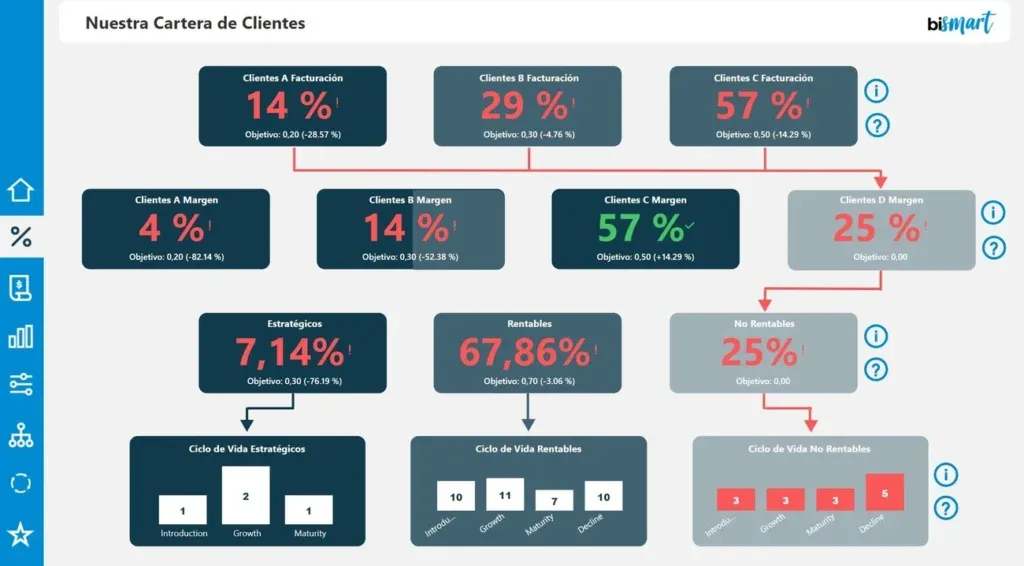
Image Source: Blog de Bismart
Static measurement systems miss valuable insights that AI now reveals by showing how different KPIs affect each other in complex business environments.
Linking market share and profit margin KPIs
Companies now realize that better performance measurement depends on understanding KPI relationships rather than just improving single metrics. A $10 billion global spirits company, Pernod Ricard uses AI to strengthen connections between profit margins and market share—metrics previously managed separately. Sales and marketing focused on market share while finance concentrated on profitability, which created conflicting goals.
Pernod Ricard now optimizes both KPIs at once through AI implementation and understands how investments affect both objectives. Their chief digital officer explains, “If you can imagine moving a cursor between market share optimization objectives and margin optimization objectives, you need to know how the required investments vary to reach these objectives. AI provides that information”.
Cross-functional KPI alignment using AI platforms
Companies that use AI to share KPIs boost alignment between functions five times more effectively. Business units can break free from traditional silos and this encourages collaboration across departments.
DBS Bank’s leadership created cross-functional teams to boost customer focus and profitability—a major change from their traditional approach where departments managed separate KPIs. They spent three years developing a value map that connected customer experience, employee experience, profitability, and risk. Then they used AI to identify key relationships among performance drivers.
KPI interdependencies in customer journey mapping
AI-powered customer journey mapping has transformed how businesses optimize customer interactions. In fact, companies using AI segmentation see up to 25% revenue increases and 30% improvements in customer retention.
AI dashboards automatically collect and analyze data to give teams live insights intocustomer behavior and priorities. Teams can see all customer data in one place, which helps sales and marketing work together toward shared goals.
Organizations can identify metrics that truly affect outcomes by looking at KPI relationships across the customer journey. This viewpoint leads to smarter resource allocation and more effective strategic decisions.
Smart KPI Governance and Oversight Models
KPI governance is now crucial to maximize AI performance. Today, 60% of managers know they need better KPIs, but only one-third (34%) make use of AI to create new ones.
KPI portfolios and meta-KPIs
Smart governance is moving to optimize complete KPI portfolios instead of single metrics. Organizations need “KPIs for their KPIs”—meta-level metrics that review the efficiency and lineup of the KPIs themselves. These meta-KPIs look at reliability, utility, improvement potential, and the overall value of performance indicators.
Executive accountability for KPI evolution
AI-powered metrics need clear accountability structures. The CEO or senior leadership team must take responsibility for the AI governance charter. Governance approaches fail without assigned responsibility. Performance Management Offices (PMOs) work well to oversee KPI development and ensure metrics line up with strategic goals as objectives progress.
AI transparency and explainability in metric design
Transparency forms the foundation of effective AI metrics, with explainability at its core. Complete metrics include Transparency Scores that measure data homogeneity, documentation completeness, and algorithm modularity. Leading organizations review explainability through Feature Importance Spread, which measures concentration of feature importance, and Surrogacy Efficacy Scores that measure how well simple rules can explain AI predictions.
Conclusion
AI reshapes business operations, and measurement approaches must evolve. Traditional KPIs can’t capture the complexity, speed, and interconnectedness of AI-driven systems. Static standards lack adaptability, fail to account for standard contamination, and work as lagging indicators instead of up-to-the-minute performance gages.
Smart organizations use the three-tier measurement framework. Descriptive metrics track performance in real time. Predictive metrics forecast outcomes, while prescriptive metrics provide AI-generated recommendations. This complete approach helps you monitor current performance, anticipate future trends, and determine the best actions.
Technical evaluation metrics need a fresh look. F1 scores now replace simple accuracy measurements, especially with imbalanced datasets where traditional metrics can mislead. You just need to balance precision-recall trade-offs based on your business context. Latency and throughput metrics have become vital for real-life AI applications.
AI creates new strategic metrics that were impossible to imagine before. Unsupervised learning spots hidden performance drivers. Customer lifetime value calculations reach new levels of precision. Behavioral metrics find meaning in previously unmeasured micro- interactions.
Learning how different KPIs affect each other is a vital advancement. Companies using AI to connect previously siloed metrics report five times better cross-functional coordination. This connected view helps optimize multiple objectives at once instead of chasing conflicting goals across departments.
Smart KPI governance completes this shift through meta-KPIs that review your measurement system. Clear accountability structures and transparency mechanisms keep your metrics lined up with strategic objectives as business conditions change.
The message is clear - your organization should welcome these AI-powered measurement approaches or risk falling behind competitors. Companies that update their AI performance metrics are three times more likely to see better financial benefits than those stuck with outdated systems. Only 34% of managers currently use AI to create new KPIs, but this transformation will without doubt speed up as competitive advantages become clear.
AI performance measurement has changed forever. Will you lead this transformation or struggle to catch up?