
AI Pricing Analytics: Hidden Patterns That Drive 30% BetterMargins
AI pricing analytics reshapes how businesses plan their revenue strategies by revealing hidden patterns that traditional pricing models miss.
Traditional pricing methods often leave money on the table with heavy users while pricing out customers who have lower usage needs.
AI-driven pricing brings a radical alteration to your business toolkit rather than just adding another feature. Your business can move beyond
manual adjustments and broad assumptions that limit profitability by using dynamic pricing algorithms and machine learning capabilities. AI
can customize user experiences based on individual priorities and lead to higher satisfaction rates while reducing operational costs. But
some pricing algorithms might participate in behaviors that don’t benefit consumers in competitive scenarios.
AI pricing optimization helps you learn about valuable patterns in customer behavior and explores dynamic pricing machine learning
applications. These strategies can lead to 30% better margins. The applicable information in this piece will help you turn pricing
challenges into profit opportunities, especially if you face pricing inconsistencies, customer retention issues, or need to maximize
revenue from your product features.
Quantifying AI-Driven Value in Pricing Models
“Data-driven pricing is essential in the digital age.” — Marc Benioff, Chairman and CEO of Salesforce, leading authority on digital transformation and enterprise technology
AI’s role in pricing models can be measured by looking at how it affects operational efficiency, customer behavior, and financial results. Companies that use advanced pricing systems are getting returns that make their investment worthwhile.
Efficiency Gains from AI-Powered Automation
AI-powered pricing makes traditional pricing processes much better. Many companies know they need to be more productive with pricing but still face problems. A detailed study showed that in one high-tech company, 68% of quoting time went into reviewing and approving prices. Electrical distributors lose money because they can’t update their price lists fast enough to match market changes.
These problems happen because:
-
Market models don’t connect different data sources well
-
Too many people make decisions separately
-
Old systems look only at past data
-
Companies worry about setting prices too high or too low
AI solves these issues with automation and immediate updates. Companies using AI-powered pricing solutions save up to 30% on operational costs and work 50% faster. The automation also cuts down on mistakes and helps teams make price changes quickly.
Customer Retention Metrics from Personalized Pricing
It costs five to six times more to get new customers than to keep current ones. AI helps create customized pricing that keeps customers happy. Smart algorithms look at customer data to spot who might leave, so companies can offer better prices to keep them.
Telecom companies now use AI to find the right service prices for each customer, which makes them more money. A big electronics company made 15% more profit by using AI to adjust its prices.
AI also helps companies group customers based on how they buy and react to prices. When a SaaS company started using AI to suggest different pricing tiers, they got 10% more renewals and happier customers. Sephora’s AI beauty program brought 25% more customer activity and made people spend 10% more per order.
Revenue Impact of Predictive Analytics in Pricing
Predictive analytics turns pricing from guessing into science. Companies that use it see better results than those who don’t:
| Metric | With Predictive Analytics | Without Predictive Analytics |
|---|---|---|
| Revenue Growth | 5-15% | 0-3% |
| Profit Margin Increase | 5-15% | 0-2% |
| Customer Retention | 5-10% | 0-2% |
| Inventory Turnover | 10-30% | 0-5% |
Source:
AI-powered dynamic pricing can boost revenue by up to 25% and profits by up to 15%. The numbers look even better with 15-20% better pricing and promotions, 1-3% more sales, and 2-5% higher margins.
Retailers who switch from old rule-based systems to AI pricing make 5% to 10% more gross profit. These systems also help customers feel they’re getting better value because prices change more accurately based on market conditions.
Uncovering Hidden Patterns with AI Pricing Analytics
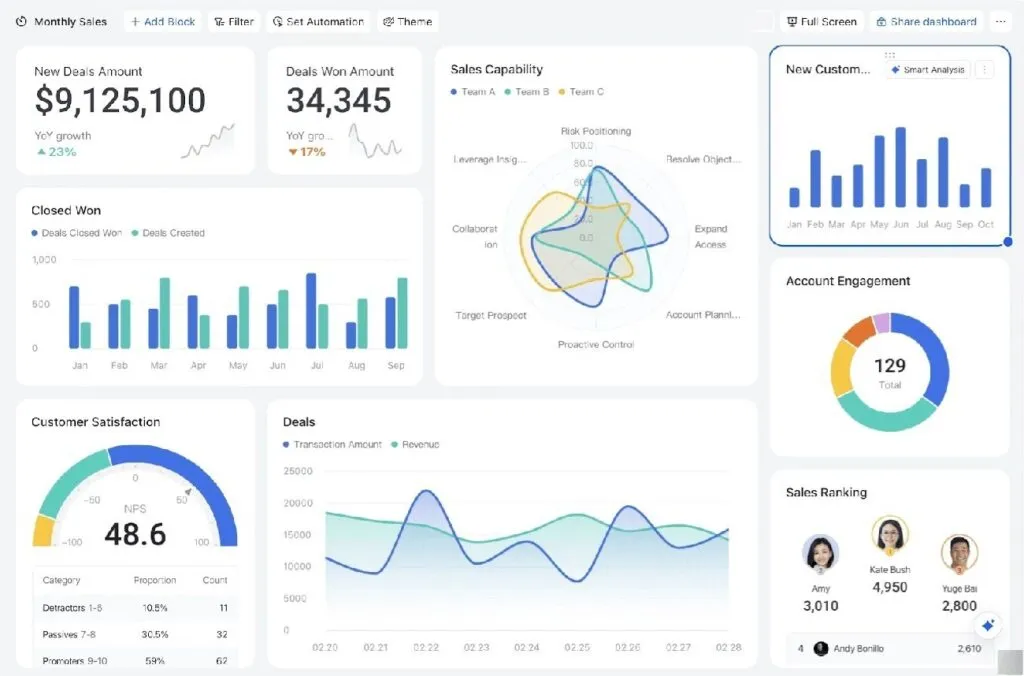
Image Source: Lark
Traditional analytics often miss the wealth of useful insights hidden beneath basic pricing data. AI pricing analytics helps businesses find these hidden patterns and gives them a clearer picture of what makes customers buy across different segments.
Dynamic Pricing Algorithm Behavior Across Segments
AI-based pricing algorithms turn static pricing into a data-driven process by analyzing huge datasets from customer behaviors, competitor pricing, inventory levels, and demand trends. These algorithms work non-stop and adjust prices based on current market conditions using advanced techniques like reinforcement learning.
The most powerful feature is how well it handles segmentation. AI pricing algorithms can spot segment-specific behaviors that regular analysis would miss. Businesses can create pricing strategies that fit geographic, demographic, psychographic, and behavioral segments. A car dealership struggling with too many products can use AI pricing to group historical sales data into matching customer and product sets, which helps set the best prices for each group.
Identifying High-Margin Customer Cohorts
AI-powered customer cohort analysis helps you examine metrics to find behavior patterns and growth opportunities. AI spots meaningful patterns in how customers spend money instead of using one-size-fits-all pricing logic, and shows differences in what people will pay.
AI creates segment-based cohorts grouped by:
-
Subscription plan/pricing tier
-
Product type
-
Acquisition channel
-
Original or average investment (spend-based grouping)
This detailed analysis shows which customer types bring in more money over time. Spend-based cohort analysis helps find pricing tiers that create the most long-term value and shows where customer churn happens most. Sales teams can focus on profitable segments and adjust their resources based on this information.
Detecting Underpriced Features Using Usage Data
AI pricing analytics excels at finding features that are worth more than their current price. These tools look at how people use products alongside pricing data to spot chances for value-based price changes.
AI-powered cataloging software scans data sources and flags items sharing traits with previous bestsellers. This helps with:
-
Finding premium features that many use but pay standard prices for
-
Spotting services priced below their true value based on customer use Finding pricing mistakes that could cost lots of money
Usage analysis reveals features customers actively use but don’t think about when buying—perfect candidates for tiered pricing structures.
AI-Driven Price Elasticity Mapping
Price elasticity shows how demand changes when prices change across products, markets, and customer segments. AI pricing analytics creates detailed elasticity maps that go far beyond traditional methods.
Modern AI lets companies calculate price elasticities for individual SKUs in point-of-sale segments. Elasticities can change based on external factors like:
-
Number of competitor SKUs at the point-of-sale
-
Competitor presence nearby
-
Population density in the area
Each channel might show different elasticities. One SKU might resist price changes in stores but be very sensitive online where people can compare prices easily. Online channels work better for dynamic pricing with automatic updates as demand shifts.
Advanced AI tools like Pricefx now handle 100 billion data points monthly, and their predictive elasticity dashboards forecast demand with 92% accuracy. The best systems learn from new data and feedback to improve pricing models over time.
Implementing Tiered and Usage-Based AI Pricing Models
AI pricing models are the life-blood of making money from artificial intelligence solutions. Companies must know how to structure prices that line up with how customers see value. This helps capture the right revenue and leads to green practices in this fast-evolving space.
Hybrid Pricing with AI Feature Tiers
Hybrid pricing models stand out as the best way to price AI services. They mix consumption-based and value-based pricing structures. These models give flexibility by letting businesses charge a base fee for access to AI tools.
Customers pay extra based on the value they get. Yes, it is a way to make sure prices match both usage and customer benefits.
Hybrid models come with several benefits:
-
New customers build trust by starting with usage-based pricing before moving to value-based tiers
-
Risk goes down since providers don’t rely on just one pricing structure
-
Base fees make income predictable while variable layers tied to performance help providers grow with their clients .
Some companies show great examples. Intercom blends AI into its customer communication platform. They charge a base subscription plus extra for AI-powered solutions. Notion uses a similar approach with a base plan and optional AI features at a small extra cost.
Usage-Based Billing for Tokenized AI Services
Tokens form the base of many AI pricing models. They help systems track and manage usage. AI applications use tokens as text chunks when creating or understanding language. This lets providers charge based on what customers actually use instead of flat fees.
Token-based pricing brings clear advantages: costs match real usage, customers can predict expenses, demand stays balanced, and it works for both subscriptions and pay-as-you-go plans. OpenAI shows this well with ChatGPT and API services where users pay per 1,000 tokens.
Setting this up means defining token usage as a measured metric, creating usage-based price plans, and running automatic billing. Many vendors now add usage pricing to their flat-rate models. In fact, 53% of subscription businesses now use some form of usage pricing.
Dynamic Pricing Machine Learning in Real-Time Adjustments
State-of-the-art pricing strategies now use machine learning for real-time price changes. These systems can adjust prices automatically based on customer groups, what people will pay, and what competitors charge.
AI algorithms look at customer data non-stop to create pricing strategies for different customer levels. The systems spot patterns in buying behavior. Prices change instantly based on current conditions. Results help make future decisions better.
An Asian online marketplace used this to watch competitor prices and change its own prices. They stayed competitive while keeping profits healthy. A European auto parts supplier also changed prices based on material costs and what competitors charged.
Optimizing Margins with Real-Time Feedback Loops
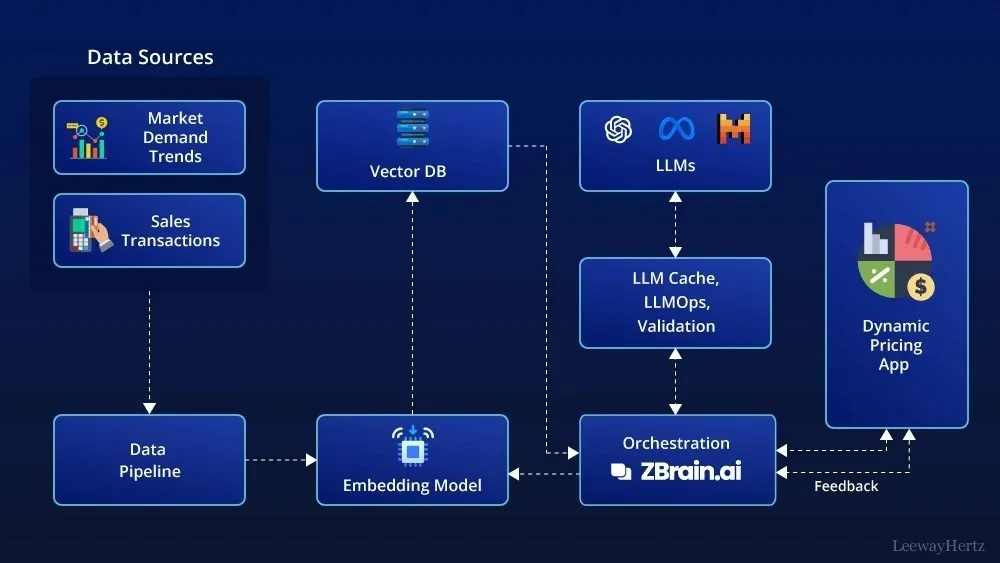
Image Source: LeewayHertz
“Automation can optimize pricing for maximum efficiency.” — Reed Hastings, Co-founder and Executive Chairman of Netflix, pioneer in digital business models and automation
Live feedback systems make the real difference between modest AI pricing success and exceptional profit gains. These feedback loops turn basic pricing models into smart systems that keep getting better.
A/B Testing AI Pricing Strategies
A/B testing removes all guesswork from pricing decisions. You can test different prices with actual customers before making permanent changes. The best part? You can reverse everything during testing, which lets you try bold experiments without worrying about negative reactions. Your testing process should focus on these key factors:
-
Sample sizes play a big role in pricing tests because even small changes can lead to big revenue effects
-
Tests must factor in seasons, customer groups, location differences, and what competitors are doing
-
Look at the complete customer experience instead of just the first sale
Incorporating Customer Feedback into Pricing Models
Strong customer communication helps you understand how they value your products. Surveys give direct insights about pricing and promotions. Research shows 60% of consumers like brands that ask for their input. New pricing strategies need clear communication. Your customers should see the benefits of any changes you make.
Professor Sukki Yoon from Bryant University points out that while live price changes boost profits and competitiveness, small business customers notice price shifts more easily. The data shows transparent pricing can boost customer loyalty by 15%.
30% Margin Gains from Adaptive Pricing Loops
Companies using AI-driven adaptive pricing have seen amazing results. One client’s dynamic pricing solution led to a 30% jump in margins and improved competitive position by 500 basis points while maintaining stable revenue. Overall, well-executed AI dynamic pricing increases profits by 22%.
The perfect pricing strategy needs constant monitoring. Retailers who follow this approach see their pricing accuracy improve by 25% over time. You can achieve similar results - try our small business calculator to estimate potential margin improvements from AI pricing analytics.
Tools and Platforms for AI Pricing Optimization
The success of AI pricing optimization depends on choosing the right tech infrastructure. Modern platforms come with special features that can handle complex pricing models while keeping operations smooth.
Using Zentitle for AI Usage Tracking
Zentitle works as a flexible pricing engine that helps you design, apply, and fine-tune licensing and pricing models faster. This cloud-based platform lets you test and improve different pricing strategies. You can launch new models in days instead of months. A major benefit is that you can separate engineering from your market strategy—you’ll launch any business model without changing your products.
When it comes to AI services, Zentitle stands out by tracking computational resource usage in AI-enhanced features. Its sophisticated metering systems monitor everything from API calls to processing power consumption. The result is a connected asset management system that tracks and optimizes software usage with precision.
Hyperline for Real-Time Billing Adjustments
Hyperline brings together every part of your revenue process from contracts to cash collection. The platform handles almost any pricing model—flat fees, usage-based, tiered structures, or advanced enterprise contracts. Its flexible engine grows with your business. The best part? Revenue teams need no engineering work to set up and run pricing plans in minutes.
Built-in features include usage-based billing, smart retries, up-to-the-minute alerts, and AI monitoring. The platform merges with payment providers to handle multiple currencies and payment schedules.
Integrating CRM and ERP with Pricing Engines
AI pricing works best when your pricing engine connects with existing business systems. PROS Smart Price Optimization and Management (POM) shows this by bringing pricing data together and linking pricing with selling processes. It merges naturally with ERP, CRM, CPQ, eCommerce platforms, and customer portals to create one source of truth for pricing data.
These connected systems handle millions of daily price requests even in unstable markets. They deliver calculations instantly without delays. Companies that use such connected pricing solutions see higher revenue, better margins, and happier customers through more precise dynamic pricing strategies.
Conclusion
AI pricing analytics leads the way in business strategy and offers unique advantages to companies that embrace data- driven decision making. This piece shows how AI finds valuable patterns in customer behavior. These patterns lead to margin improvements that traditional pricing approaches can’t match.
The numbers tell the story clearly. Companies using AI-powered pricing solutions see up to 30% better margins. They also keep their customers happier and longer. These systems cut operational costs through automation and remove the inefficiencies of manual pricing processes.
Your experience toward better pricing starts with knowing your customer segments and their behaviors. AI excels at finding high-value groups, spotting underpriced features, and mapping price elasticity with precision. This knowledge becomes your edge in today’s fast-moving market.
Hybrid and usage-based models work particularly well. They help arrange pricing with actual customer value while securing appropriate revenue. These flexible approaches help build trust with new customers and adapt as relationships grow.
Live feedback loops change your pricing from fixed policies into systems that keep getting better. A/B testing removes uncertainty. Customer feedback helps your strategies stay in tune with market expectations. The outcomes speak for themselves. Companies report 30% margin gains along with better market position and steady growth.
Want to see similar results in your business? Think about how tools like Zentitle and Hyperline can combine smoothly with your current systems to implement AI-driven pricing strategies. The rewards are nowhere near the original investment, especially when you look at the compound effect of better pricing across your product line.
Strategic pricing gives you the most powerful way to grow profits. The experience needs dedication and expertise, but the way forward looks clear. Start today - book your Pricing Pulse Audit to find how AI pricing analytics can turn challenges into profit opportunities for your business.