
How Data-Driven Pricing Boosts Subscription Revenue: Real Numbers
Data driven pricing is changing how businesses grow. Recent surveys show 96% of companies expect to increase revenue this year. This is a big deal as it means that two-thirds of these companies expect growth above 20%.
Companies that make use of information and hybrid pricing strategies see double the growth and margin gains compared to their competitors. Your subscription pricing strategies can work just as well with smart data analysis. AI segments subscribers by their usage patterns, demographics, and activity levels. This creates custom pricing plans that maximize revenue.
Numbers tell the compelling story: AI has become the leading technology priority for innovative businesses. About 77% name it their #1 tech investment - up 67% from last year. Companies that use data-based pricing decisions are more likely to forecast growth (96% vs. 69%). This matters especially when you have hybrid shoppers who split purchases between online and in-store channels. These customers are the most active users of subscription services.
In this piece, you’ll learn to implement smart data-driven pricing strategies that boost subscription revenue with measurable results. You’ll see how to create detailed customer segments and predict responses to price changes. Data driven dynamic pricing can turn your subscription business into a growth engine.
Challenges in Subscription Pricing Without Data
Businesses take a huge risk by setting subscription prices without analyzing their data properly. The impact on profits can be severe. Research shows 45% of businesses face revenue leakage, and companies lose about 9% of their annual revenue because they don’t have good pricing strategies.
Subscription businesses face these major challenges without data-based pricing:
-
Pricing model complexity becomes too hard to handle, which creates structures that customers can’t understand and accounting systems can’t process well
-
Forecasting inaccuracies make decision-making difficult, as 93% of finance executives can’t access live forecasting tools and 87% admit their forecasts are outdated when presented
-
Customer churn rates go up significantly, with software businesses losing an average of 3.5% customers monthly, mostly because customers aren’t happy with pricing
-
Revenue leakage happens through pricing mistakes that go unnoticed, which can reduce earnings by 1-5%
Subscription businesses that don’t use data to make pricing decisions end up reacting to problems instead of planning ahead. Corporate finance teams spend about 80% of their time collecting and checking data manually, so they can’t focus on analysis and growing revenue.
Customer behavior makes things even more complicated. Companies miss valuable insights about how customers use their products and what they think about pricing without proper data analysis. Statistics show that 40-60% of users quit after trying a product just once, and nearly 9 out of 10 customers have left companies because of bad experiences.
Subscription fatigue has become a big problem, and more than half of subscription business leaders know this. Companies that don’t use data-based pricing strategies can’t spot early signs that customers are unhappy or find the right price points that keep both profits and customers.
The problems get worse over time. Static pricing models leave businesses unable to adapt to market changes, which leads to lost money and smaller profit margins.
Implementing a Data-Driven Pricing Strategy
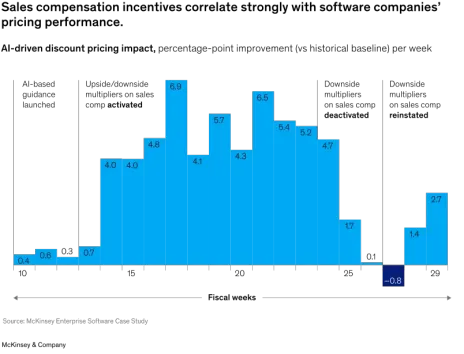
Image Source: McKinsey
“Pricing analytics shows which segments are the most profitable and how different groups react to price changes. Once you know this information, you can design specific pricing plans that fit each type of customer.” — Stefan Chekanov, Co-Founder and CEO of Brosix
Data-driven pricing success depends on analyzing customer behavior systematically. You must segment your audience based on purchase patterns, usage behaviors, and participation levels to use pricing data well.
Customer segmentation builds the foundation of strong pricing strategies. Your audience should be divided into distinct groups using behavioral metrics such as:
-
Purchase behavior: Categorize customers by frequency, timing, and motivation behind purchases
-
Usage patterns: Identify heavy, medium, and light users to adjust offerings
-
Engagement levels: Track how customers interact with your product across touchpoints
-
Customer loyalty: Measure retention patterns and lifetime value potential
A/B testing becomes your most powerful tool after establishing segments. You can test different price points, package offerings, or billing frequencies while monitoring key metrics like conversion rates, churn rates, and subscriber lifetime value.
The best results come from testing with smaller, specific audience segments before scaling up. Research shows 70% of customers fall within a specific price sensitivity range—between $50-$78 for many subscription services. This knowledge helps you target either mass market share or higher-value segments with custom pricing.
Dynamic pricing builds on this approach by adjusting prices based on market demand, customer behavior, and competitive factors in real-time. Companies can maximize revenue during peak periods while staying competitive during slower times.
AI-powered analytics platforms have become crucial tools that analyze usage patterns, customer behavior, and market dynamics to find optimal price points. These platforms let you create tailored pricing models where clients pay based on
actual usage or participation—a strategy that worked exceptionally well for companies like FT Professional.
Regular testing and data analysis will help you find the pricing strategy that boosts both customer satisfaction and subscription revenue. Your pricing model will evolve from static guesswork to precise profit generation.
Measurable Impact on Subscription Revenue
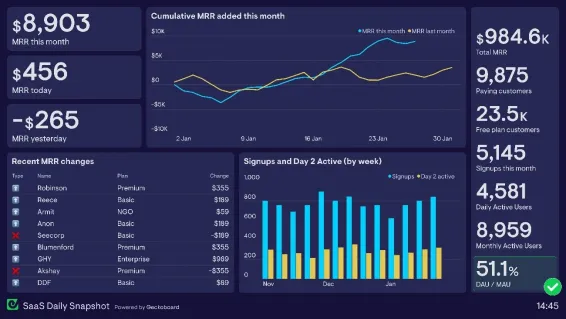
Image Source: Geckoboard
“Each of the three final pricing strategy options we presented to our client offered an estimated 22% lift in revenue, conservatively.” — RevGen Partners Data Science Team, Consulting firm specializing in data driven revenue growth
Numbers paint a clear picture of how companies benefit from analytical insights in subscription pricing models. Research shows subscription businesses grow their revenue substantially and keep more customers when they use sophisticated pricing analytics.
Hydrant’s success story stands out with its 260% higher conversion rate and 310% increase in revenue per customer. The company used predictive AI to spot potential churners and run targeted campaigns. Their quick shift to smarter email segmentation took just two weeks and showed how fast analytical pricing can boost results.
A global IT services provider saw about a 5% increase in earnings after building a pricing framework backed by data analysis. A large enterprise software company pushed pricing adjustments up by an additional 3% by creating a dedicated pricing control tower with analytics capabilities.
Small improvements can lead to big gains. A mere 1% boost in customer retention can increase income by 6.71%. The impact grows as 5% better retention raises profits by 25% to 95%. These numbers prove why retention-focused pricing strategies work so well.
Usage-based pricing models beat traditional approaches. Companies using these strategies see 54% higher revenue growth and achieve revenue multiples of 21.6x versus 14.4x compared to their competitors.
Data shows a direct link between predictive analytics and growth potential. Growing companies are 1.7 times more likely to use advanced analytics in their pricing decisions. They also tend to be 1.4 times more likely to invest heavily in product and strategic pricing teams.
Successful companies track these essential metrics:
Monthly Recurring Revenue (MRR) growth
Customer Lifetime Value (CLV) to Customer Acquisition Cost (CAC) ratio
Churn reduction percentages
Average Revenue Per User (ARPU)
One subscription company used data-driven pricing strategies for specific customer segments and grew from $1,000 to $100,000 in MRR. They reached $32 million in Annual Recurring Revenue. Another company achieved over $100,000 MRR growth in under a year while reducing churn through smart pricing strategies based on analytics.
Conclusion
Evidence-based pricing has proven to be a powerful driver for subscription business growth. The numbers throughout this piece back this up clearly. Companies that use AI-powered pricing strategies perform better than their competitors and achieve up to 260% higher conversion rates with 310% increases in revenue per customer. These results come from customer segmentation, usage analysis, and dynamic pricing adjustments.
Your business can see similar remarkable results by moving from static pricing models to evidence-based strategies. Customer segmentation forms the foundation that lets you tailor offerings based on actual behavior rather than assumptions. A/B testing shows which price points strike a chord with each segment, while predictive analytics help you spot market changes before they affect your revenue.
Numbers tell the story clearly - even small improvements bring substantial returns. A tiny 1% boost in retention can increase income by 6.71%. Companies using usage-based pricing models see 54% higher revenue growth compared to those using traditional approaches. Subscription pricing success depends on knowing how to match prices with how customers perceive value.
On top of that, you get competitive edges through early warning systems for churn risk, optimized pricing tiers, and individual-specific offerings that boost lifetime value. These features turn pricing from guesswork into a precise revenue-generating system. **Subscribe for more insights on data-driven pricing strategies and subscription revenue optimization** as you develop your approach.
Evidence-based pricing decisions create an upward spiral of improvement. Each pricing change produces new data that sharpens your understanding of customer behavior. This leads to more accurate predictions and profitable pricing strategies. This ongoing refinement process helps your subscription business achieve steady, predictable growth in today’s competitive marketplace.