
How Netflix Built a $1B AI System for Personalized Subscriptions: CaseStudy
Netflix’s AI has transformed the way 282 million subscribers in 190 countries watch TV and movies. Today’s Netflix experience puts you in touch with one of the most advanced recommendation systems that powers 80% of what people watch on the platform.
Netflix users spend about 3.2 hours daily watching content, and the platform’s recommendations influence 75% of their viewing choices. This remarkable success story began in 1997 with a simple DVD rental service that grew into a streaming powerhouse within ten years. The company needed a smart way to help viewers find shows they’d love, so they poured resources into building a smart recommendation system that learns and adapts to your specific preferences and viewing patterns.
Product analytics helps Netflix understand its audience through behavior analysis, recommendation algorithms, and viewer engagement metrics. The AI system creates a unique viewing experience each time you sign in. This piece explores how Netflix built their billion-dollar AI system that became crucial to their success.
The Scale Problem: Why Netflix Needed a $1B AI System
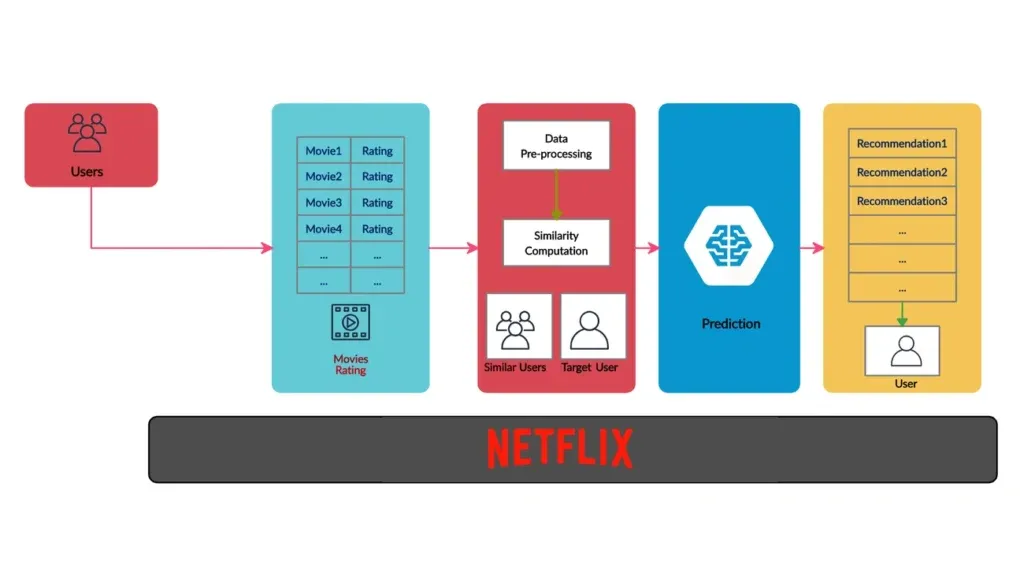
Image Source: Towards AI
Netflix’s massive operation creates unique challenges for content delivery. Their subscriber count reached an impressive 301.6 million globally by August 2025, showing a 15.9% jump from 2023 to 2024. Such a huge user base creates personalization challenges that only advanced AI can address.
Over 260M Subscribers with Unique Priorities
Netflix users come from vastly different demographics with distinct viewing preferences. The platform’s largest market remains the United States with 81.44 million subscribers. The United Kingdom follows with 18.4 million, while Germany and Brazil each have 16.59 million users. Each viewer expects content that matches their specific interests. In fact, 81% of viewers expect streaming platforms to provide individual-specific experiences. Traditional recommendation systems can’t handle these massive computational requirements.
Choice Overload in a 10,000+ Title Library
The platform’s big content library creates an interesting paradox - too many choices can paralyze decisions. Research indicates that users often feel overwhelmed by Netflix’s extensive catalog. A study revealed that users spent at least 10 minutes browsing options, sometimes taking up to 30 minutes. The numbers paint a concerning picture - 48% of users have left a streaming service because they couldn’t find anything to watch. Netflix’s AI system must quickly narrow down thousands of options to a manageable, personalized list.
Global Diversity and Language Variability
Netflix operates in more than 190 countries, facing challenges of cultural and language differences. Content that appeals in one region might not work in another. The company adapts everything from content and pricing to cover user interfaces and payment methods.
Their recommendation system needs to understand these cultural subtleties while maintaining quick response times globally.
The financial impact speaks volumes - Netflix’s personalization algorithms save them over $1 billion yearly by keeping subscribers from leaving. Their algorithmic recommendations drive 75-80% of all viewing hours, rather than manual searches. This makes their AI system not just a technical achievement but the main force behind Netflix’s success.
Inside the Netflix Recommendation System Architecture
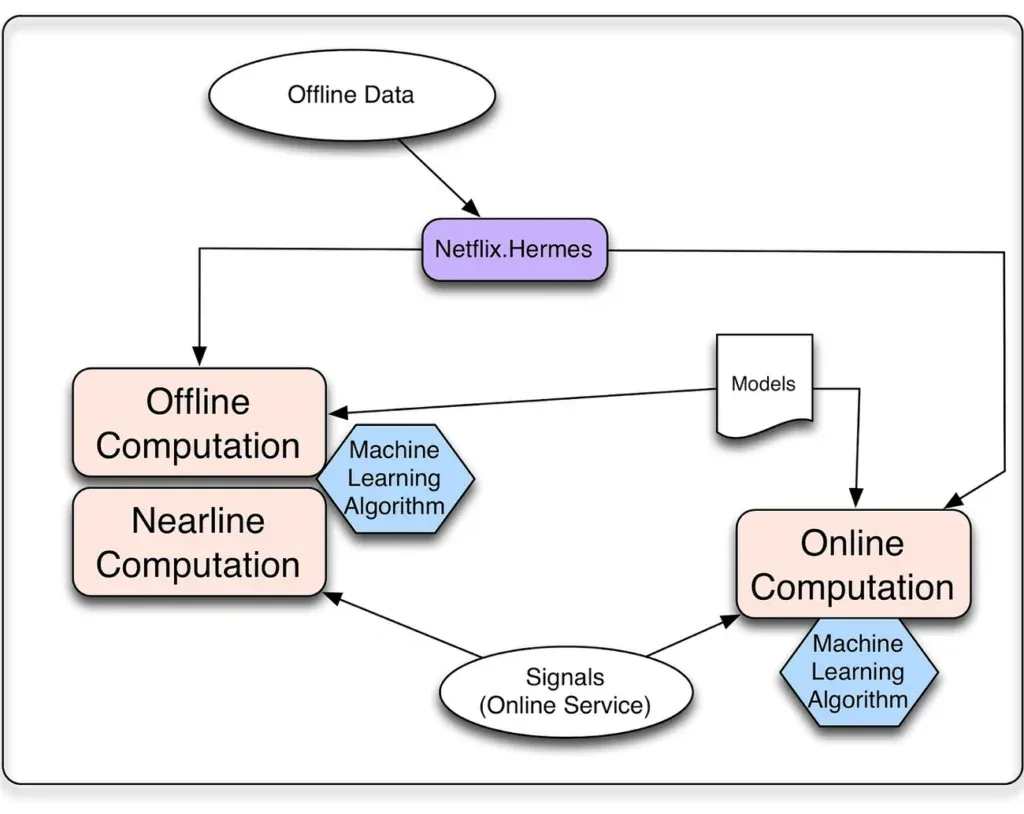
Image Source: Netflix TechBlog
Netflix’s recommendation engine gets into massive data collections through complex algorithms that deliver targeted content suggestions. The system processes billions of data points to understand what you might want to watch next.
User Behavior Signals: Watch Time, Skips, Ratings
The system captures behavioral signals that include viewing duration, pause patterns, skip behavior, search queries, device context, and time patterns. These interactions create sparse, high-dimensional data that conventional machine learning doesn’t deal very well with. Your actions—whether you finish a series or abandon a show halfway—help Netflix learn about your priorities.
Content Metadata: Genre, Cast, Themes, Duration
Netflix tags content carefully using detailed metadata categories. The system has genres, themes, cast information, release year, and duration. Their AI uses video and audio analysis to learn directly from content. It analyzes color palettes, camera angles, and soundtracks to categorize content with more detail.
Collaborative Filtering vs Content-Based Filtering
The platform uses both major recommendation approaches. Collaborative filtering spots patterns based on similar users’ behaviors—if people who liked the same shows as you watched something specific, Netflix might suggest that show to you too. Content-based filtering looks at features of shows you’ve enjoyed and suggests titles with similar characteristics.
Matrix Factorization and Latent Feature Modeling
Matrix factorization remains central to Netflix’s approach, despite advances in deep learning. This technique breaks down the sparse user-item interaction matrix into dense latent factor representations that capture hidden preference patterns. These models link users and items with vectors in a shared “latent factor” space and create interpretable dimensions of user taste and content characteristics.
Contextual Bandits for Real-Time Personalization
Netflix uses contextual bandit algorithms to balance exploration versus exploitation for dynamic adaptation. This system tests new recommendations against your known preferences and adapts live to your changing interests. The algorithm discovers which content gets more engagement for specific user contexts and thus encourages more interaction patterns.
AI Infrastructure Behind Netflix Personalization
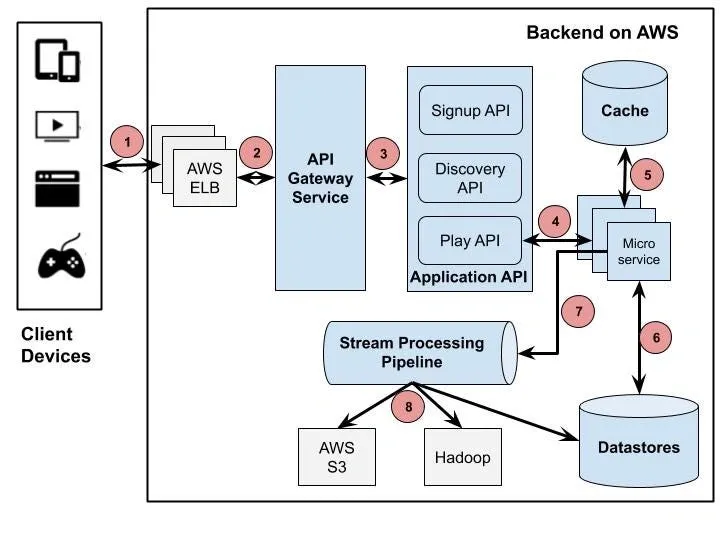
Image Source: Medium
Netflix’s impressive personalization features rest on a strong technical foundation that processes trillions of events each day. This powerful system helps Netflix recommend the right content to viewers worldwide.
Data Ingestion with Apache Kafka and Cassandra
Netflix’s data pipeline depends on Apache Kafka to stream data in real time. The system handles over 700 billion messages daily through 36 Kafka clusters. Viewer interactions from millions of devices flow into the system simultaneously. Netflix’s storage solution uses Apache Cassandra that excels at high-volume writes and quick reads—these features help manage up-to-the-minute metrics. Together, these technologies create Keystone, Netflix’s unified system to transport, process, and route data.
Model Training with TensorFlow and Horovod
Netflix employs Horovod with TensorFlow for distributed model training. Workers communicate directly with each other through a “ring-allreduce” algorithm, which removes the need for parameter servers. The system makes use of NVIDIA’s NCCL2 library to optimize bandwidth between workers. This substantially speeds up training across multiple GPUs.
Online Learning and Continuous Model Updates
Stream processing systems detect user interactions and update feature stores within seconds. Users’ viewing behavior changes trigger immediate system adaptations during active sessions. The system runs resource-intensive operations during quiet hours through batch processing workflows.
Microservices Architecture for Scalability
Netflix builds its recommendation system on independent microservices. The architecture separates user profiling, content analysis, and model serving components. This design lets Netflix scale each service independently by adding more servers as needed.
Beyond Recommendations: Other AI Use Cases at Netflix
Netflix’s recommendation system attracts attention, but AI powers many more critical functions throughout the platform. These AI applications improve user experience beyond suggesting what to watch next.
Auto-Generated Thumbnails Using CNNs
Netflix uses a sophisticated process called Esthetic Visual Analysis (AVA) to create individual-specific thumbnails for each piece of content. Research shows thumbnail artwork affects 82% of browsing time and stands as the most important factor in viewer choices. A single hour of “Stranger Things” produces about 86,000 potential thumbnails. The system uses convolutional neural networks to assess each frame based on brightness, contrast, face detection, and composition principles like the “rule of thirds”. These thumbnails change dynamically based on your viewing history.
Streaming Quality Optimization via Bandwidth Prediction
Netflix serves over 117 million members worldwide, and continuous connection quality presents huge technical challenges. AI algorithms predict network changes and adapt video quality live. This results in a 50% reduction in buffering events on mobile networks. Machine learning models anticipate bandwidth changes by analyzing user data such as network type, location, and time of day. The system pre-buffers content and prevents interruptions even in areas with poor connectivity.
Content Investment Decisions Based on Viewer Trends
Netflix analyzes viewing patterns to predict success probability before greenlighting productions. Evidence-based decisions led to producing “House of Cards”—Netflix knew the show would succeed after studying how many users watched similar movies completely, viewed the British version, or watched other Kevin Spacey films. This strategy helps Netflix achieve a 70% show renewal rate compared to traditional networks’ 35%.
A/B Testing for UI and Algorithm Improvements
Netflix tests every feature rigorously before rollout. Their AI-powered testing platform identifies statistically significant results automatically and customizes winning variants for different user segments.
Want to learn how AI drives business decisions and pricing strategies? Subscribe now to get exclusive corporate pricing insights and see how companies like Netflix make use of AI to optimize revenue.
These experiments determine everything from thumbnail selection to adaptive streaming configurations. The “Top 10” feature visible in the interface underwent testing to assess whether it improved overall member engagement—Netflix’s main goal for decision-making.
Conclusion
Netflix shows how AI can revolutionize a business model. Their $1B AI system has become the foundation of their subscriber experience. This powerful system now drives 80% of all viewing activity.
The company faced major challenges with its hundreds of millions of subscribers who had different priorities. Their massive content library caused choice paralysis, and cultural diversity spread across 190 countries made things complex. They built a smart solution that saves over $1 billion each year by keeping subscribers from canceling.
Netflix’s recommendation engine works behind the scenes to process billions of data points. It uses both collaborative and content-based filtering approaches. Their matrix factorization techniques and contextual bandit algorithms keep your recommendations fresh and relevant.
The system’s technical foundation is remarkable. Apache Kafka handles over 700 billion messages daily while Cassandra takes care of storage needs. This setup allows the system to work globally while staying responsive in networks of all types.
Netflix uses AI beyond just recommendations. Their thumbnail generation system shapes 82% of browsing decisions. The bandwidth prediction algorithms cut buffering by 50%. Their analytical insights for content investment have helped Netflix double the show renewal rate compared to traditional networks.
The Netflix case proves that good AI needs more than just algorithms. It needs smart architecture, resilient infrastructure, and non-stop optimization. Streaming competition keeps growing, and Netflix’s investment in personalization technology gives them a unique advantage. This advanced AI ecosystem creates a personalized experience every time you open the app. Netflix isn’t just a content provider - it’s a tech company that happens to excel at entertainment.