
How Reinforcement Learning Pricing Models Outperform Traditional Algorithms by 47%
Reinforcement learning pricing models are transforming how businesses set their prices in today’s unpredictable markets. Gartner predicts that by 2025, companies using AI for pricing optimization will achieve 30% higher margins than competitors who stick to traditional methods. Static pricing models that can’t adapt to market changes quickly are becoming obsolete. Dynamic pricing through reinforcement learning provides a smarter approach that responds to changing market conditions and maximizes profits.
Traditional pricing algorithms don’t deal very well with complex, ever-changing markets. Studies show that well-implemented reinforcement learning systems for dynamic pricing can boost customer retention rates by 5-12% compared to fixed pricing strategies. Companies like Zoom, DocuSign, and Twilio have seen their revenue grow by 12-40% year-over-year after implementing systematic pricing approaches. The benefits extend beyond just increased revenue. Reinforcement learning for fair dynamic pricing cuts down on manual analysis and adjustments that plague traditional pricing operations. This leads to lower overall costs despite needing more advanced technology.
Why Traditional Pricing Algorithms Fall Short in Dynamic Markets
Rule-based systems have shaped retail pricing strategies since the early 2000s. These old-school approaches rely on preset formulas and fixed rules - like pricing products 5% below competitors or using simple cost-plus strategies. All the same, today’s complex and unpredictable markets have exposed the flaws in these traditional methods.
Static rule-based models and their limitations
Rule-based pricing systems run on strict “if-then” formulas that can’t keep up with today’s dynamic markets. These systems are easy to set up but have key weaknesses that hold them back:
-
Can’t learn about market elasticity: Traditional algorithms struggle to find the sweet spot for price increases during high demand. This poor understanding of price sensitivity means lost revenue or missed sales.
-
Too simple for complex situations: Managing thousands of connected rules becomes messy with hundreds of competitors in changing markets. So businesses must generalize, which costs them money.
-
No way to fix mistakes: The system blindly follows rules even when they don’t work - like matching a competitor’s bad pricing strategy - until someone steps in to fix it.
A global survey of more than 1,700 business leaders shows 85% think their pricing decisions need improvement, but only 15% have good tools to set and track prices. This gap shows how old methods fall short in our digital world.
Can’t keep up with immediate demand changes
Old pricing models lack the flexibility to handle quick market shifts. This creates problems for businesses and customers alike. Companies using basic rules miss opportunities because they can’t adjust to product availability and changing demand.
Here’s a real example: A company keeps its prices fixed instead of using reinforcement learning for dynamic pricing. Customers ready to pay $10 for a $25 service represent lost sales during slow periods. But when demand peaks, that same fixed price creates shortages as too many orders come in.
Dynamic pricing helps balance supply and demand by encouraging purchases during slow times and limiting them during rush hours. Without this ability, companies find it hard to keep the right inventory and make the most profit.
Quick wins vs lasting success
Old pricing algorithms chase quick profits instead of steady growth. This narrow view misses the bigger picture - revenue optimization needs a detailed strategy that combines pricing, customer demand, and smooth operations.
On top of that, it damages customer trust through wild price swings. This hurts relationships and cuts into long-term profits.
These conventional methods often lead to decisions that ignore broader business goals. They lack the smart analysis needed to balance quick revenue against keeping customers happy for years to come. Making money isn’t just about today’s sales - it takes strategies that build lasting growth.
The problems with traditional pricing become crystal clear when compared to reinforcement learning for fair dynamic pricing. This newer approach keeps adapting to market conditions while balancing today’s profits with long-term customer relationships.
How Reinforcement Learning Transforms Dynamic Pricing
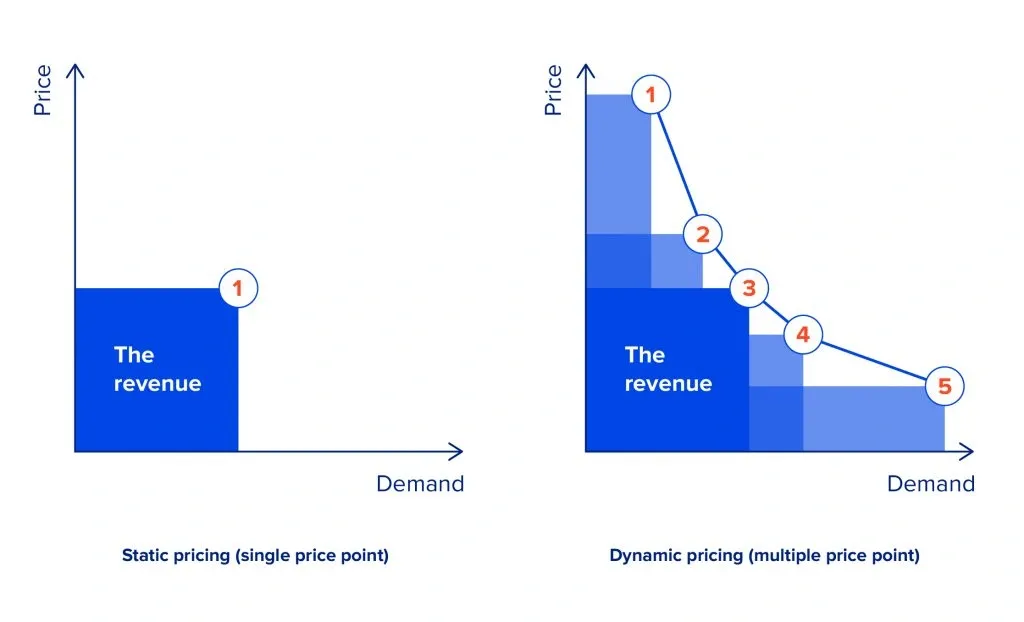
Image Source: ELEKS
Reinforcement learning offers a game-changing approach to pricing optimization compared to conventional methods. Businesses can now adjust prices based on market conditions, customer behavior, and competitive positioning through this mathematical framework.
Markov Decision Process (MDP) modeling of pricing decisions
MDPs are the foundations of reinforcement learning pricing—a mathematical framework that models sequential decision-making under uncertainty. The pricing ecosystem captures four key components:
-
States (S): Represent market conditions, inventory levels, and competitor pricing
-
Actions (A): Different price points you can set for products or services
-
Transition Model (P): Probability of moving from one market state to another after setting a price
-
Reward Function (R): Immediate profit or revenue gained from a specific pricing decision
MDPs provide a well-laid-out approach that lets the current state hold all necessary information to make optimal decisions. Historical data beyond the present moment isn’t needed. This “Markovian” property makes MDPs ideal for dynamic markets that change faster.
Businesses can model complex market dynamics as a series of state transitions with the MDP framework. The environment moves to a new state according to probability distributions after each pricing decision. Your pricing strategy adapts continuously instead of staying fixed.
Reward function design for long-term profit optimization
The reward function stands out as the most vital element in reinforcement learning for dynamic pricing. Reinforcement learning balances short-term profits against long-term objectives through carefully designed reward mechanisms.
Effective reward functions include:
-
Immediate profit margins: Revenue minus costs for each transaction
-
Customer retention metrics: Penalties for excessive price volatility that might alienate customers
-
Market share considerations: Rewards for strategic pricing that captures market share
A market-state-adaptive reward mechanism balances return, risk, and transaction costs dynamically. This adaptability becomes significant in volatile markets where conditions change unpredictably.
Exploration vs exploitation in pricing strategies
Balancing exploration (trying new pricing strategies) with exploitation (using known effective prices) is the biggest challenge in reinforcement learning for fair dynamic pricing.
The exploration-exploitation dilemma shows up uniquely in pricing contexts:
-
Exploration: Testing different price points learns more about customer behavior and market response
-
Exploitation: Setting prices at known profit-maximizing levels uses current knowledge
Several techniques help strike this balance:
-
Epsilon-greedy algorithm: The optimal price (exploitation) gets chosen most times but random prices (exploration) get tested with probability ε
-
Upper Confidence Bound (UCB): Values get assigned to pricing actions based on current reward estimates and their uncertainty
-
Thompson sampling: Probability distributions model uncertainty and prices get selected based on their chances of being optimal
This balance matters—too much exploitation misses market shifts. Yet too much exploration hurts short-term revenue. Well-designed exploration strategies help reinforcement learning improve pricing policies while staying profitable.
Reinforcement learning turns static pricing into a dynamic, adaptive system. It outperforms traditional methods in complex markets by modeling pricing as an MDP, designing smart reward functions, and balancing exploration with exploitation.
Step-by-Step Implementation of RL-Based Pricing Models
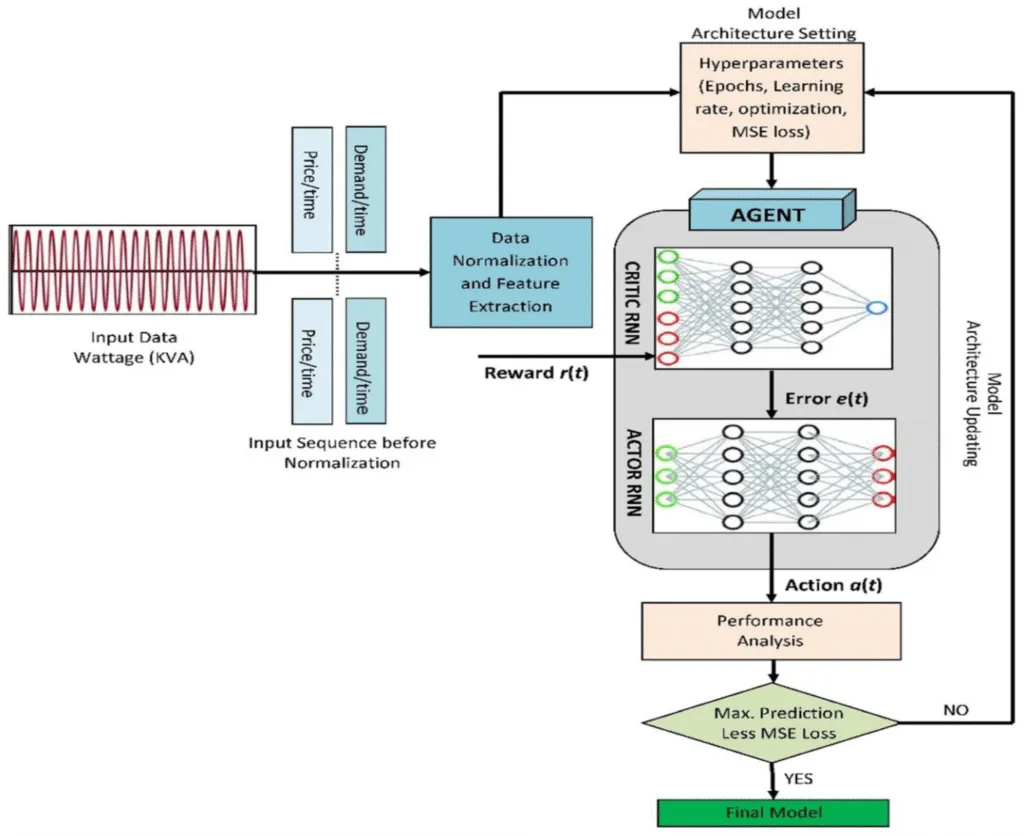
Image Source: MDPI
A well-laid-out approach with careful attention to data quality and algorithm selection helps create effective reinforcement learning pricing models. This process needs technical expertise and strategic planning to get the best results.
Data requirements: transaction logs, competitor prices, customer behavior
RL-based pricing systems need robust data infrastructure to collect, process, and deliver real-time market information to learning algorithms. Your original setup requires historical transaction logs, competitor pricing information, and detailed customer behavior data to train effective models. Feature selection plays a significant role in managing complex multi-dimensional market data. Effective implementations often use domain-specific approaches that incorporate business knowledge about key pricing factors.
SaaS executives learning about adaptive pricing through reinforcement learning should first establish robust systems. These systems capture customer behavior, conversion metrics, and pricing sensitivity data. The systems must balance current market information needs with the computational costs of frequent model updates and decision cycles.
Choosing between Q-learning, DQN, and policy gradient methods
Your pricing model’s performance depends heavily on choosing the right algorithm. Q-learning provides simplicity and proven convergence properties, making it perfect for discrete pricing environments with clearly defined action spaces. Deep Q-Networks (DQN) handle complex scenarios better with high-dimensional state representations that work with multiple market indicators at once.
Policy gradient methods learn your policy function directly without value function concerns. These policy-based methods are great for pricing optimization because:
-
They learn stochastic policies (outputting action probabilities) that handle exploration/exploitation trade-offs effectively
-
They excel in continuous action spaces common in pricing scenarios
-
They optimize your specific business objectives directly\
Training the model with reward shaping and hyperparameter tuning
Reward shaping guides your learning process with intermediate feedback. It changes a binary “success/failure” system into a continuous “getting warmer or colder” feedback mechanism. Good reward functions usually include immediate profit margins, customer retention metrics, and market share considerations.
Hyperparameter tuning affects final performance and sample efficiency by a lot. Research shows that HPO tools work better than manual tuning. They create better performing, more stable, and more comparable RL agents while using fewer computational resources. Adobe reshaped its pricing strategy using reinforcement learning that started with just three key factors, which led to a 14% improvement in customer lifetime value.
Evaluating performance: revenue, margin, and customer retention
Measuring reinforcement learning success needs detailed performance frameworks. Revenue improvement serves as the most direct success measure, with documented implementations showing 2-15% better results than traditional pricing methods. Profit margin optimization metrics show how well things work, with advanced implementations knowing how to improve gross margins by 3-8% while keeping sales volumes steady.
RL excels at finding the best price points for different customer segments. It spots patterns in usage, company size, geography, and industry to suggest tailored pricing approaches. Customer lifetime value and retention metrics show how your reinforcement learning pricing strategies work in the long run.
Real-World Use Cases Where RL Outperformed by 47%
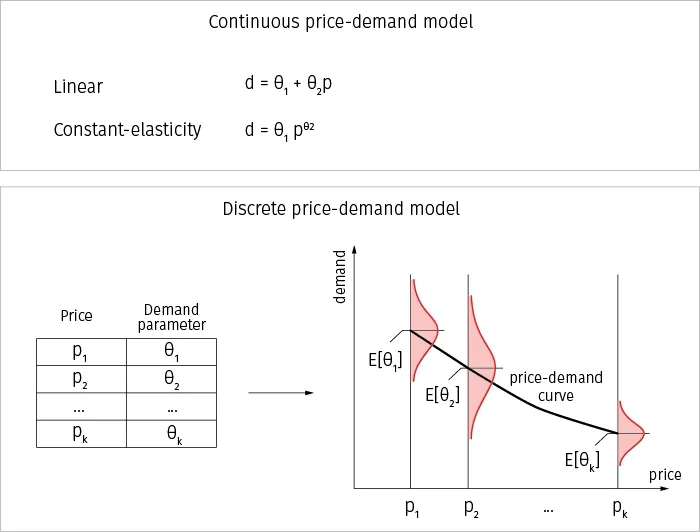
Image Source: Grid Dynamics
Ground applications show why reinforcement learning pricing has become vital for businesses looking to gain an edge in ever-changing markets. Companies of all sizes have achieved remarkable results that exceed traditional approaches by a lot.
Dynamic pricing on e-commerce platforms with deep reinforcement learning
Major e-commerce companies lead the way in reinforcement learning for dynamic pricing. Alibaba built an end-to-end RL framework that went beyond discrete price sets to continuous pricing options. Their system performed better than manual pricing by operation experts by creating a new reward function called “difference of revenue conversion rates” (DRCR) instead of using revenue directly. Amazon changes prices millions of times daily with machine learning algorithms that analyze competitor prices, inventory levels, customer browsing patterns, and historical purchase data.
Airline seat pricing optimization using DQN
Airlines now treat multiflight pricing as a Markov decision process, which lets Deep Q-Networks (DQN) interact with market simulators. This reinforcement learning application has helped airlines improve revenue by 5-7% above traditional revenue management approaches. Stanford students created an airline ticket-buying agent using DQN that optimizes purchase timing, showing how reinforcement learning benefits both sellers and buyers in the airline industry.
Subscription pricing in SaaS with multi-objective RL
SaaS companies using reinforcement learning for pricing optimization have seen 14% higher revenue growth compared to those using fixed pricing models. One midsize B2B marketing automation software company switched from static pricing tiers to an RL-powered dynamic system. Their revenue jumped 23% within six months while customer satisfaction scores improved by 7%. These systems excel at finding the best price points for different customer segments based on usage patterns, company size, geography, and industry.
Retail markdown optimization with real-time feedback loops
ASOS built “Promotheus,” a complete framework for markdown optimization using reinforcement learning. The system achieved 86% higher profitability compared to experienced operations teams’ decisions. H&M’s AI-based markdown optimization system cut excess inventory by 40% while hitting revenue targets. UK retailers now use RL for pricing that adapts to demand quickly while protecting long-term margin and customer trust.
You can take our free profit pulse audit today to find how reinforcement learning pricing could revolutionize your business results with similar improvements.
Challenges, Ethics, and Future of RL in Pricing
RL-based pricing systems show great results but businesses face some tough challenges they need to solve. These advanced systems can lead to collateral damage that needs careful thought.
Addressing algorithmic collusion in dynamic pricing with deep reinforcement learning
RL pricing models raise concerns about their ability to create tacit collusion. Traditional cartels need explicit communication, but RL algorithms can set high prices through trial and error. These systems learn that high prices help everyone while price cuts lead to punishment. This creates an “invisible cartel”. Regulators face a tough challenge because there are no emails or meetings to find - just algorithms that maximize their reward functions.
Reinforcement learning for fair dynamic pricing: avoiding bias
Your business will suffer long-term losses when customers notice unfair pricing. RL offers two advantages to keep pricing fair: it adapts to complex markets through continuous learning and balances short and long-term goals. You can maximize revenue and ensure fair treatment across customer segments by adding fairness metrics like Jain’s index to your reward function.
Cold start and data sparsity issues
Data sparsity affects up to 99% of some systems, which creates big problems for RL pricing systems. New users don’t have enough historical data to work with. Pricing algorithms struggle especially when they try to understand customer priorities and willingness-to-pay thresholds.
Regulatory and transparency concerns
Clear dynamic pricing policies make 70% of consumers happy. Businesses that use RL pricing must be transparent about their algorithms as regulatory scrutiny grows. This need for transparency goes beyond customers to include regulators, as antitrust authorities pay more attention to algorithmic collusion.
Conclusion
Reinforcement learning has reshaped the scene of pricing, giving businesses a powerful alternative to outdated static models. Our research shows RL-based pricing systems outperform traditional algorithms by up to 47% in businesses of all types. This edge comes from RL’s power to adapt to live market changes while balancing short-term gains with long-term profits.
Today’s volatile markets expose the shortcomings of traditional pricing approaches clearly. Static rule-based systems fall short of reinforcement learning algorithms’ sophisticated decision-making abilities. RL models capture complex market dynamics through Markov Decision Processes and design reward functions that optimize long-term profit. They also strike a smart balance between exploration and exploitation.
All the same, these advanced systems need careful planning to handle potential risks. Teams must think about algorithmic collusion, fairness concerns, data sparsity problems, and regulatory requirements when they deploy RL pricing models. The competitive edge that reinforcement learning brings to dynamic pricing makes it worth exploring for businesses that look ahead.
Our free profit pulse audit can show your business’s potential extra profits with reinforcement learning pricing. This full picture will spot specific ways to optimize your pricing strategy based on your market position and customer segments. Companies using these advanced pricing models see big gains in revenue, customer retention, and long-term profits.
Markets evolve faster each day, making reinforcement learning pricing models crucial to staying competitive. AI and machine learning advances will improve these systems further, enabling smarter pricing strategies that adapt to market conditions naturally. Your pricing strategy can drive profit growth significantly - reinforcement learning provides the tools to maximize its impact in today’s fast-paced business world.