
How to Build a Modern Data Analytics Stack for Pricing: A Practical Guide 2026
A surprising fact: 85% of organizations plan to keep some on-premises analytics by 2025. But most companies use only 30 percent of their cloud resources—sometimes even less than 10 percent. This waste emphasizes a major challenge companies face when they try to optimize their pricing strategies.
Companies need a strategic approach to build a modern data analytics stack for pricing that balances cloud capabilities with real-world use. Your analytics stack’s foundation rests on the warehouse. It powers all pricing decisions. Modern data stack tools have proven their worth through remarkable results. To name just one example, Frontify achieved a 40% BI adoption rate, which towers above the industry’s 25% average. On top of that, companies now move away from old on-premises systems toward modern, flexible, cloud-native stacks that support AI and decentralized workflows.
This piece will show you how to build a data analytics stack that optimizes pricing. You’ll learn the steps to turn raw data into applicable pricing strategies. The process starts with centralizing pricing data sources and ends with teams using these insights effectively. The framework works whether you struggle with old analytics tools or want to boost your current setup. It helps create informed pricing decisions that stimulate profit and growth.
Defining the Modern Data Analytics Stack for Pricing
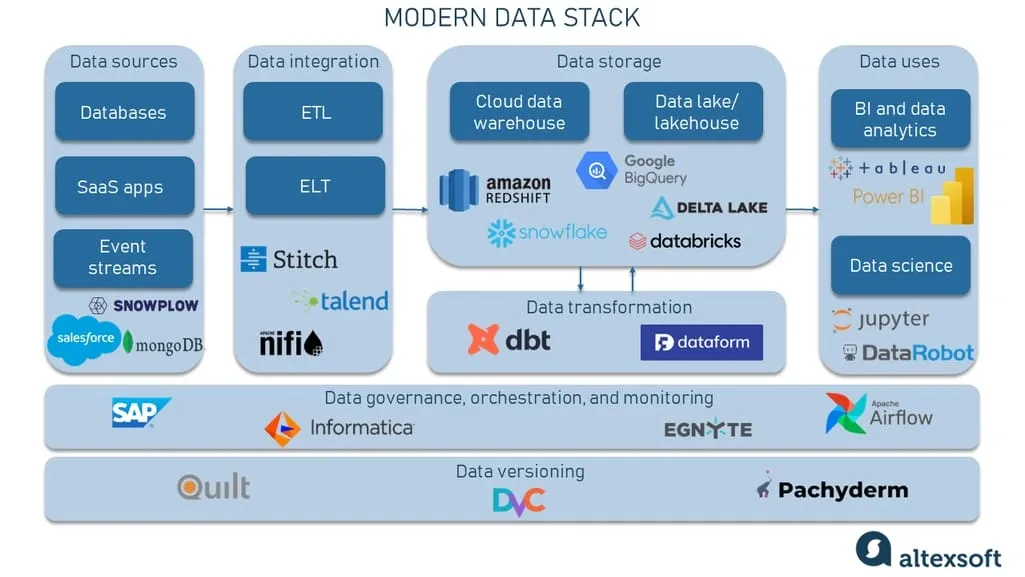
Image Source: AltexSoft
“Organizations are shifting from legacy on-premises systems to modern, flexible, cloud-native stacks that support AI and decentralized workflows.” — Alation, Data intelligence platform provider
The modern data analytics stack has changed dramatically as companies moved from on-premises solutions to cloud-based architecture. This development has fundamentally changed how businesses handle pricing analytics. Companies now just need a specialized set of tools and methods to get maximum value from pricing data.
Key components: ELT, data warehouse, BI tools
A reliable pricing analytics infrastructure has three basic parts that work together to turn raw pricing data into useful insights:
Extract, Load, Transform (ELT) represents a radical alteration from traditional ETL processes. ETL transforms data before loading, but ELT first pulls data from various sources, loads it into a central repository, and then transforms it as needed. This approach works better in cloud environments where storage is elastic and compute power is abundant. ELT pipelines load data faster and offer more flexibility when handling large volumes of pricing data.
Data warehouses are the foundations of your pricing analytics stack. Modern cloud data warehouses like Snowflake and BigQuery offer massive, scalable compute power to process complex pricing information. These platforms handle large amounts of data using parallel processing, optimizers, and flexible storage. On top of that, they support semi-structured formats such as JSON, so you can load pricing data as it comes and decide later how to structure it.
Business Intelligence (BI) tools complete the stack by turning complex enterprise data into useful insights through visual dashboards. These tools help you track gross margin trends, pricing performance by customer and product line, sales rep compliance, and revenue optimization. Executives and stakeholders get full visibility that makes pricing data available and easy to understand.
Why pricing analytics needs a specialized stack
Pricing analysis comes with unique challenges that just need specialized tools. Price decisions involve multiple variables like costs, competitor prices, customer segments, and market conditions. Standard analytics setups don’t deal very well with these specific requirements.
AI-driven pricing platforms adapt to cost changes, demand shifts, and competitive pressures in real time. Unlike static pricing tools, these specialized platforms optimize prices continuously at the SKU, customer segment, and market levels. This dynamic capability helps companies thrive in today’s volatile markets.
Your pricing analytics must integrate with existing enterprise systems. Price recommendations should flow directly from your analytics platform into CRM, ERP, or manufacturing software systems. This smooth integration gives sales teams clear pricing guidance at the point of sale. The result is 95% compliance with reduced discount leakage and pricing exceptions.
A specialized pricing stack handles unique data transformation tasks effectively. Pricing data often requires normalization for currency, taxes, and discounts to ensure accurate analysis. Incorrect handling of these elements can lead to misleading or inaccurate pricing insights.
The process of monitoring performance, providing strategic guidance, and turning pricing intelligence into measurable EBITDA improvements requires both automated systems and expert human oversight. These work together as an extension of your organization.
Your pricing analytics stack should let you test price changes safely before implementation, analyze price elasticity, and line up pricing practices with your customer’s perceived value. These capabilities enable evidence-based decisions that balance profit optimization with market competitiveness.
Step 1: Centralizing Pricing Data Sources
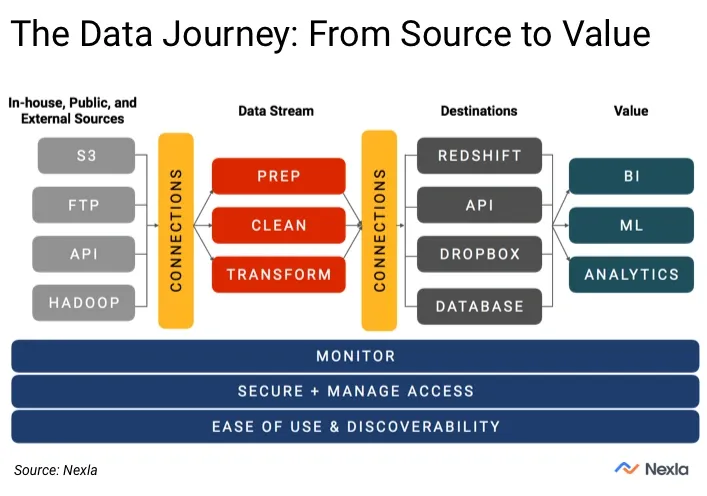
Image Source: Nexla
Your pricing analytics stack needs centralized pricing data as its foundation. Without bringing your data sources together, you might make pricing decisions based on scattered or old information. This can lead to mixed-up strategies and lost profits.
Integrating ERP, CRM, and eCommerce platforms
A single source of pricing truth puts you back in control. You can manage strategy, execution, and results from one central system. When you combine your Enterprise Resource Planning (ERP), Customer Relationship Management (CRM), and eCommerce systems smoothly, every team works with the same pricing logic.
Combined systems do more than just keep things consistent. They cut down on shipping errors, inventory problems, and data entry mistakes that bug companies using separate systems. This setup helps you:
-
Sync pricing instantly across all channels
-
Process orders automatically
-
See and manage inventory better
-
Give customers a better experience with consistent pricing
Yes, it is true that businesses with centralized data complete orders faster and serve customers better because they track products and inventory in real time.
Using Fivetran or Airbyte for pricing data ingestion
Building a modern data stack requires reliable data ingestion tools. Fivetran and Airbyte stand out as top choices to pull pricing data from different sources.
Fivetran comes with fully managed data connectors that sync data from SaaS applications, APIs, databases, and other structured sources. It has 700+ fully-managed connectors to handle pricing data sources. The system adapts to schema changes on its own, which keeps your pricing data pipelines running even when API feeds change.
Airbyte takes a different approach as an open-source option with over 300 built-in connectors. The way it charges is different from Fivetran - instead of charging by data volume (Monthly Active Rows), it uses capacity-based billing. This could mean more predictable costs as your data grows.
Both tools can automate how you extract and load pricing data, though they work differently under the hood.
Choosing a cloud data warehouse: Snowflake vs BigQuery
You’ll need a strong warehouse to store and analyze your pricing data once it’s extracted. Snowflake and Google BigQuery lead the pack in 2026.
Snowflake’s design keeps storage and compute resources separate. The platform runs on AWS, Azure, and GCP, so you can use it whatever your current setup. Standard business queries often run faster on Snowflake than on BigQuery according to TPC-H measures.
BigQuery gives you a fully-managed, serverless solution in Google Cloud Platform. It handles huge complex datasets well and includes machine learning features. The system scales up automatically as you need more computing power.
The best choice depends on a few things:
-
Cloud environment: BigQuery fits perfectly if you’re already using Google Cloud
-
Pricing model: You pay for data scanned or dedicated slots with BigQuery; Snowflake charges based on compute time
-
Performance needs: Snowflake works best for standard business queries while BigQuery excels at complex analytics
These modern tools help you centralize your pricing data. This creates a base to run advanced analytics and make smart pricing decisions.
Step 2: Transforming Raw Pricing Data for Analysis
Your pricing data needs centralization before you can turn raw numbers into analysis-ready formats. Raw pricing data provides little value until you structure, normalize and prepare it for meaningful analysis.
dbt for pricing model transformations
Data build tool (dbt) emerges as the leading solution to transform pricing data through SQL-based modeling. The tool’s Fusion-powered engine allows smart model reuse and helps companies save over 29% in compute costs. This savings comes from dbt’s capability to monitor code changes and data state.
We used dbt to create incremental models that process only new or changed pricing data instead of redoing entire datasets each time. This feature proves valuable for pricing analytics since large transaction volumes typically see minimal daily changes.
The tool goes beyond simple transformations with state-aware orchestration that keeps a live fingerprint of model code and data state. This approach will give your pricing models optimal efficiency by transforming data only when needed.
Creating pricing-specific data marts
A pricing data mart acts as a dedicated repository built specifically for pricing intelligence. This structure becomes your “single source of truth” for pricing and revenue analysis. It streamlines your pricing teams’ work and helps stakeholders communicate better.
Companies build pricing data marts in phases:
-
Original setup with transaction, product, and customer data
-
Added quotes, costs, and capacity data
-
External data integration like competitive products/prices and market events
The performance dashboard in your pricing data mart lets pricing teams quickly access vital information for decision-making: historical transactions, customer profiles, quote outcomes, costs, capacity utilization, and market data. Your data mart’s maturity allows implementation of more sophisticated pricing models.
Handling currency, tax, and discount normalization
Normalization stands as a crucial yet often overlooked part of pricing analytics. Raw pricing data usually contains mixed currencies, different tax structures, and varied discount applications that need standardization before analysis makes sense.
Currency normalization converts all pricing data to one monetary unit for accurate market comparisons. Tax normalization creates uniform representation of different tax structures in your data. Discount normalization brings consistency to promotional pricing’s impact on analytics.
These processes let your pricing team compare data accurately across markets, customer segments, and time periods. Proper normalization creates reliable foundations for price elasticity calculations, competitive positioning analyzes, and profit optimization strategies.
Step 3: Building Pricing Dashboards and Reports
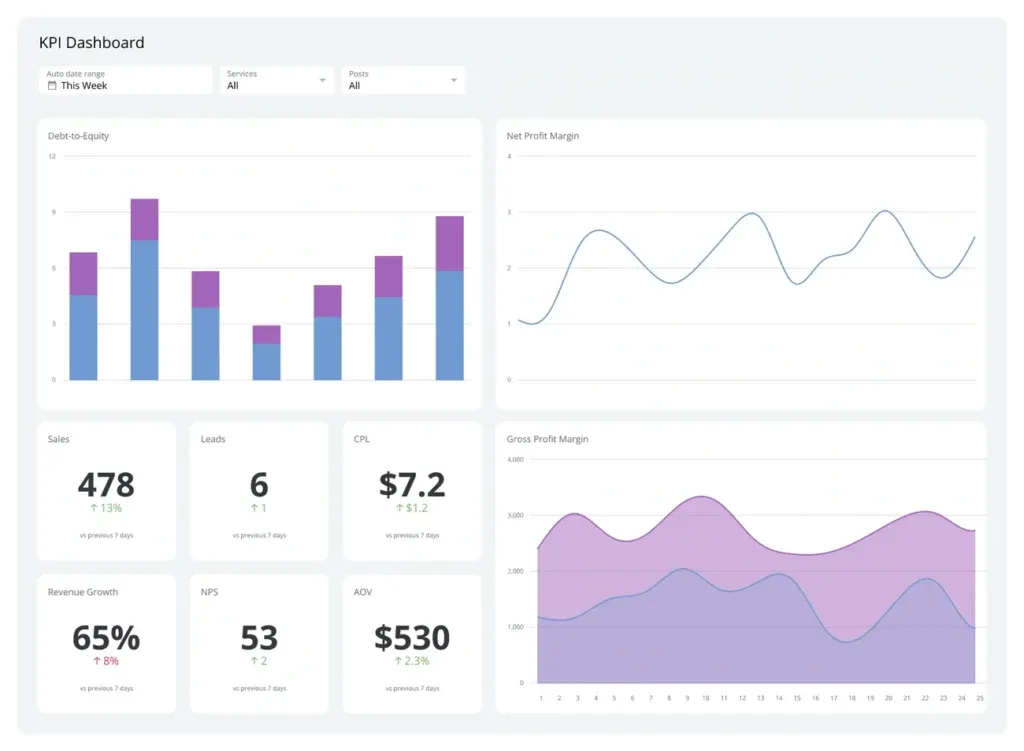
Image Source: Klipfolio
Data visualization becomes vital for decision-making after you transform your pricing information. Sales and finance teams can use well-designed dashboards and reports to turn complex pricing data into useful insights.
Using Looker or Power BI for pricing KPIs
Your choice of visualization tool determines how well your pricing data guides decisions.
Looker and Power BI have emerged as top choices in today’s data analytics stack.
Looker directly connects to your data warehouse and runs live queries instead of static dashboards. This feature is a great way to get pricing analytics since teams can work with current information without waiting for scheduled updates. This could mean the difference between winning or losing deals. Looker costs more than other options (USD 35,000-150,000/year for base costs), but it shines by providing consistent data models through its proprietary LookML language.
Power BI comes with a user-friendly interface where even non-technical users can create insightful visualizations. The Pro plan starts at USD 14 per user monthly, making it more budget-friendly for companies building their analytics stack. Built-in AI features can detect patterns, forecast trends, and spot anomalies in pricing data automatically.
Setting up immediate margin tracking
Teams get instant visibility into profitability through immediate margin tracking without waiting for settlements. Interactive charts and tables in dashboards let teams analyze data during discussions.
Your margin tracking should include these essential features:
-
Data integration with existing systems like accounting software or CRM platforms
-
Customizable metrics that fit your specific pricing model
-
Instant notifications when costs approach budget limits
Modern dashboards update data often—some systems refresh every 15 minutes. This helps teams take action before margin erosion hits the bottom line.
Automating price elasticity visualizations
Scatterplot dashboards help teams identify outliers and pricing trends in sales data. These visualizations simplify complexity by showing elasticity curves, standard benchmarks, and revenue projections together.
Price elasticity visualizations reveal how demand changes with price adjustments and show thresholds where sales drop significantly. Teams can test price adjustments before implementation through interactive scenario modeling in dashboards. Sliders and side-by-side comparisons let you try different pricing strategies and see potential effects right away.
Step 4: Operationalizing Pricing Insights Across Teams
“Modern data catalog pricing has evolved toward value-aligned models that tie costs to actual business outcomes rather than technical implementation details.” — Atlan Data Catalog Team, Data catalog platform provider and pricing expert
Getting insights from pricing data solves only half the problem—real value emerges when you put these insights to work throughout your organization. Your modern data analytics stack becomes complete when pricing intelligence becomes available and useful to all stakeholders.
Reverse ETL to push prices to Salesforce or HubSpot
Reverse ETL tools send transformed, enriched data from your cloud data warehouse back to operational systems where teams work each day. Sales reps can access current customer intelligence in Salesforce or HubSpot, which helps them prioritize leads and create personalized outreach. Marketing teams can also utilize enriched customer data to run targeted campaigns that improve engagement.
Reverse ETL creates consistent, high-quality data access for all departments. This reduces manual reporting needs and lets technical teams concentrate on higher-value tasks. Platforms like Hightouch can send data from your warehouse to over 200 destinations, serving organizations from Cars.com to Spotify.
Enabling dynamic pricing with real-time data
Modern pricing analytics stacks power dynamic pricing through three key steps: data collection, price analysis, and automated adjustment. You start by gathering up-to-the-minute market data about demand, inventory, competitor pricing, and customer behaviors. Price software then identifies opportunities or threats. Prices update automatically across channels as the final step.
Clean, connected data and AI-powered automation tools review information and update prices instantly. Companies that use AI-powered dynamic pricing can spot demand spikes weeks ahead based on internal signals (inventory, sales velocity) and external signals (weather, events, holidays).
Creating pricing alerts for sales and finance teams
Price alerts act as your pricing stack’s nervous system and notify teams when action becomes necessary. Good alerts use web scraping to gather pricing data across the web and send notifications through email, app alerts, or texts. The best systems refresh every 10 minutes, which helps companies like Amazon stay competitive.
Your alert system should grow with your business. You should track performance metrics like conversion rates, average order value, customer retention, and revenue changes. Each $1 invested in alerts should bring $5 in return.
Conclusion
A modern data analytics stack for pricing is a strategic investment that pays off through better margins, dynamic pricing, and evidence-based decisions. This piece shows you how to build a complete system that turns raw pricing information into practical insights.
Your first priority should be centralizing pricing data to create a single source of truth and eliminate fragmentation. Teams across your organization can then work with reliable, consistent information. On top of that, it transforms this data through tools like dbt to create specialized pricing models that handle complex pricing analytics, such as currency normalization and discount standardization.
Good visualization brings your pricing data to life with easy-to-use dashboards that show margins and model price elasticity scenarios up to the minute. These visual tools help stakeholders understand complex pricing relationships and spot ways to optimize quickly.
The last piece - putting insights into action - completes the cycle by feeding enriched pricing intelligence back into your everyday business tools. Your sales teams get the best pricing guidance right inside familiar systems like Salesforce or HubSpot.
Companies that follow these four steps see remarkable improvements in their pricing performance. Your modern data analytics stack becomes more than technology - it works as a strategic asset that spots profit opportunities while you retain control of competitive positioning.
Market conditions change faster and data volumes keep growing. Your investment in purpose-built pricing analytics will keep delivering value through better agility, deeper insights, and confident decision-making. The gap between random pricing approaches and systematic, evidence-based strategies often determines which businesses succeed in volatile markets and which ones struggle with profitability.