
Margin Optimization: Where AI Improves Profit Fastest
If you have budget and attention for exactly one AI-and-pricing project this year, the question is not which one sounds most advanced. It is which one returns margin fastest with the least that can go wrong. Those are rarely the same project, and the gap between them is where a lot of money and credibility gets spent for nothing.
This piece is an honest ranking. If you want one evidence-based pricing read each week, subscribe to the AI Profit Pulse newsletter.
Why price is the fastest lever
Because it is the only one with no cost attached to the gain.
A 1 percent improvement in volume brings additional variable cost with it. A 1 percent cut in fixed cost has a floor you hit quickly. A 1 percent improvement in price, with volume held, is close to pure margin. McKinsey’s distributor research found that a 1 percent price increase outperformed a 1 percent gain in volume, procurement cost, or SG&A on bottom-line margin, and in that dataset of 130 distributors was worth roughly 22 percent of EBITDA margin.
The size of that multiplier varies a lot by industry and cost structure, so treat the specific figure as directional rather than universal. The ordering, though, is consistent: price first, then cost, then volume.
The ranking, fastest to slowest
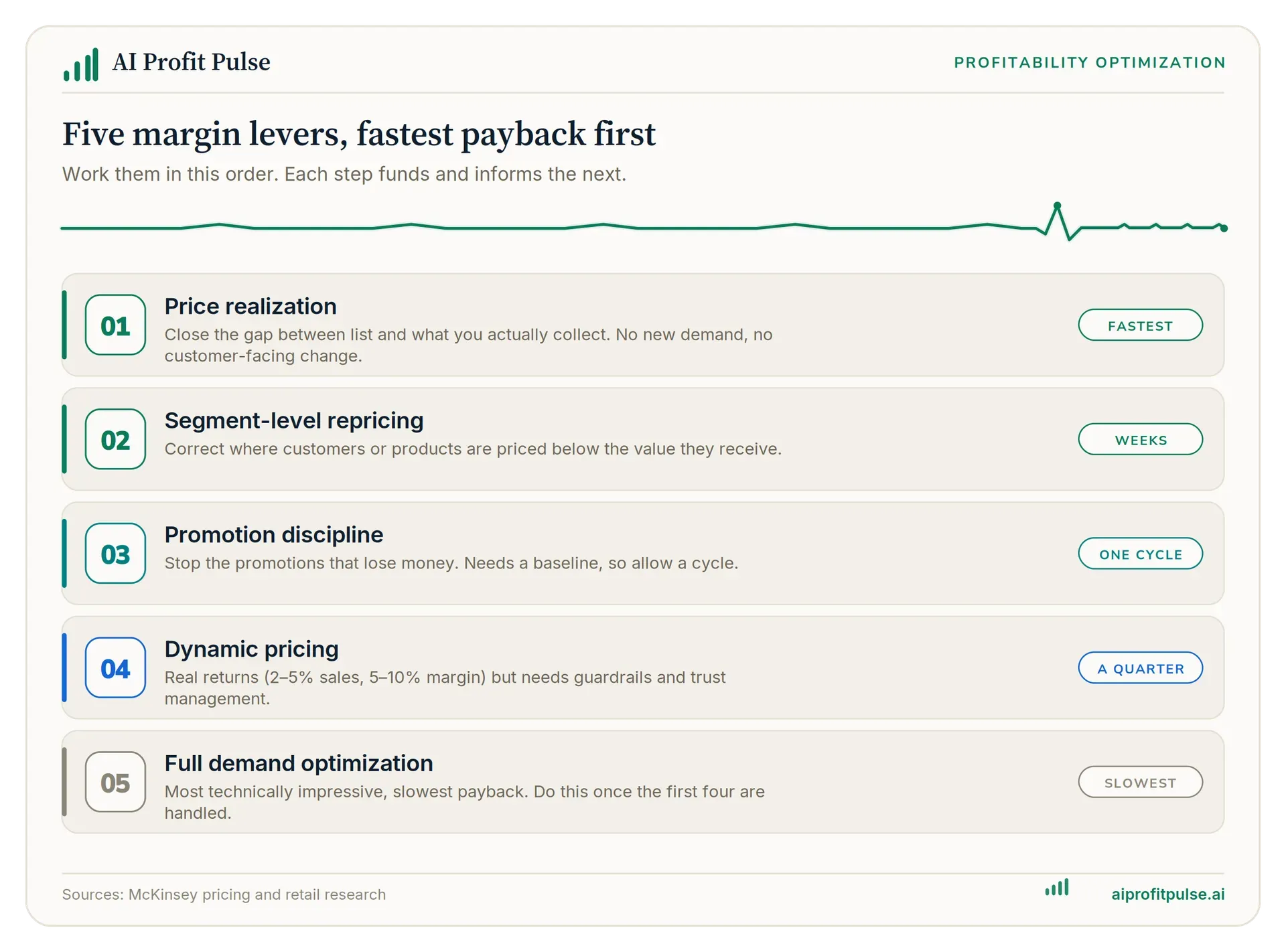
1. Price realization, the gap between list and collected. This is almost always the fastest money in the building. You already have the customers, the contracts, and the volume. The work is finding where discounts, exceptions, and unenforced terms have quietly pulled your effective price below your intended one, then closing that gap. It requires no new demand, no new product, and no customer-facing change beyond enforcement. It is also the least glamorous, which is why it stays available. The detection side is covered in how AI uncovers hidden revenue leaks.
2. Segment-level repricing. Identify which customers or products are priced below the value they receive, and correct selectively. This is faster than a broad price increase because it is targeted, and safer because you are moving prices where the evidence supports it. It needs true cost to serve to be trustworthy, which we covered in optimizing operating costs with pricing intelligence.
3. Promotion and discount discipline. Most businesses run promotions without measuring incremental lift, and a meaningful share of those promotions lose money. Stopping the unprofitable ones is margin recovered with no new work. The catch is that you need a baseline to measure against, which takes a cycle to establish.
4. Dynamic pricing. Real returns, but slower and more conditional. McKinsey’s retail research puts disciplined dynamic pricing at roughly 2 to 5 percent sales growth and 5 to 10 percent margin improvement versus static pricing. But it requires observable demand variation, guardrails, and customer trust management, so it is a quarter-scale project rather than a week-scale one.
5. Full demand forecasting and optimization. The most technically impressive and the slowest to pay back. Worth doing when the first four are already handled, not before.
What to be skeptical of
Three claims that should slow you down.
Any vendor promising a specific margin number for your business. The measured ranges are wide because outcomes depend heavily on your cost structure, category, and current pricing discipline. A precise promise is a sales tactic, not a forecast.
Projects that optimize revenue rather than contribution. A model tuned to maximize revenue will happily grow your least profitable segment. Judge every pricing change on contribution margin.
Anything that requires opacity to work. If the mechanism only produces gains when customers cannot see what is happening, the gains are borrowed against trust. Gartner found 68 percent of consumers feel taken advantage of by dynamic pricing handled without explanation, and that cost lands later, off the spreadsheet.
The sequencing that works
Start with what you already own. Close the realization gap, then reprice by segment, then fix your promotions, then consider dynamic pricing. Each step funds and informs the next, and each one is measurable on its own.
The reason this order matters is not just speed. The early steps generate the data quality the later steps depend on. A dynamic pricing system built on top of unenforced list prices and unmeasured promotions is optimizing a foundation nobody trusts.
The takeaway
The fastest margin in most businesses is not a new capability, it is the enforcement of pricing you already agreed to. Price realization, then segment repricing, then promotion discipline, then dynamic pricing, in that order. Price is the highest-leverage lever available because the gain arrives without a matching cost, but only if you work it in the order that compounds.
Want one evidence-based pricing idea in your inbox each week? Subscribe to AI Profit Pulse. And if you want to see which of these five is your biggest gap, the Pricing Pulse Audit is a short place to start.