
Pricing Intelligence: Converting Customer Signals into Market Advantage
A mere 1% improvement in price can boost your operating margin by up to 11%. Pricing intelligence turns this potential into profit, empowering you with data-driven decisions that directly impact your bottom line.
Every business owner faces the same critical challenge: pricing decisions. Too high, and customers walk away. Too low, and profits vanish until your business becomes unsustainable. This reality intensifies when 87% of shoppers check online reviews and compare prices before purchasing. Intelligent pricing helps you discover that sweet spot where revenue maximizes without sacrificing sales volume.
Competitive pricing intelligence operates far beyond simple competitor monitoring. Modern solutions combine customer behavior data with macro factors like seasonality and real-time inventory levels, calculating bespoke pricing in real time. Retailers implementing these behavioral pricing strategies achieve tangible gains—one company saw a 15% increase in promotional ROI after shifting from static offers to elasticity-informed campaigns.
Market dynamics, competitor strategies, and customer responses shape success across every industry. Pricing intelligence tools continuously analyze complex data streams on demand, elasticity, and customer behavior, giving you the power to adjust prices with surgical precision. This approach prevents harmful premature discounting that damages market positioning, while avoiding delayed discounts that create overstocked inventory and missed sales opportunities.
We help you harness pricing intelligence to convert customer signals into genuine market advantage. Through this article, you’ll discover how to turn pricing challenges into sustainable growth opportunities that drive long-term business success.
Understanding Pricing Intelligence in a Competitive Market
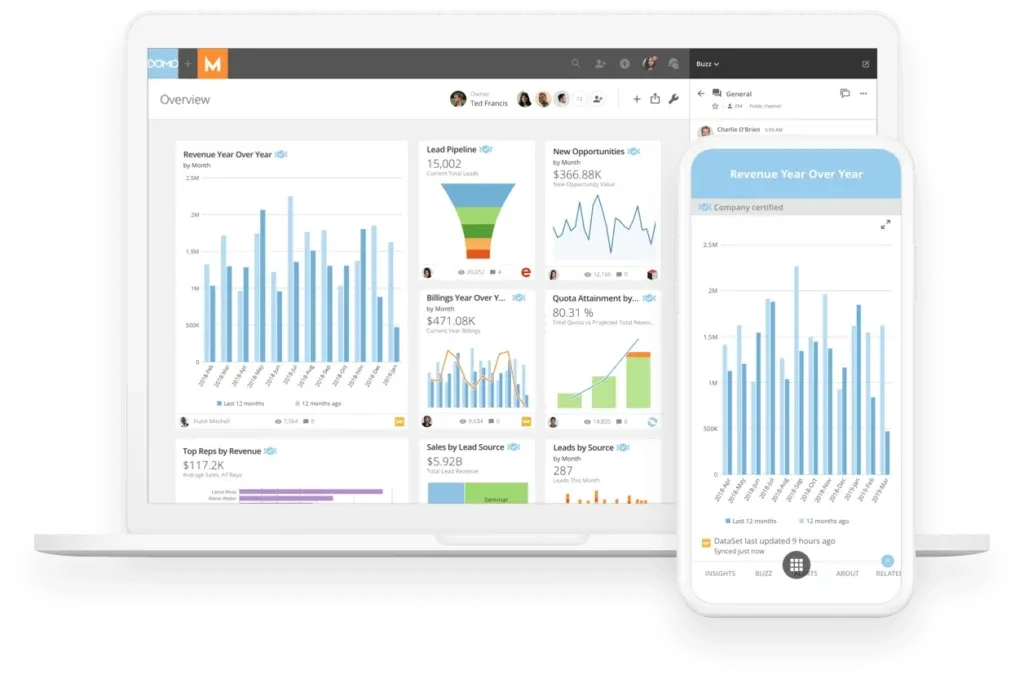
Image Source: Domo
Pricing intelligence creates sustainable growth opportunities for businesses ready to move beyond basic price monitoring. This strategic approach enables you to anticipate market shifts, respond to competitive threats, and capture new opportunities with precision.
What is competitive pricing intelligence?
Competitive pricing intelligence represents the systematic process of gathering, analyzing, and interpreting data about competitors’ pricing behaviors to optimize your pricing strategies. Rather than simply tracking competitor prices, this discipline focuses on understanding the “why” behind pricing decisions, converting raw data into actionable business insights.
At its core, pricing intelligence fuses three essential components: pricing analytics to view performance metrics, competitive intelligence to match competitor catalogs to your own, and pricing optimization algorithms that identify perfect price points to maximize revenue and profitability.
This intelligence feeds directly into key business areas, helping you make smarter decisions about market positioning. Businesses integrating competitive pricing intelligence sharpen their competitive edge, spot emerging trends, and pivot strategies to keep pace with market changes. Pricing intelligence identifies optimal price points that maintain competitiveness while protecting profit margins.
How pricing intelligence differs from traditional pricing
Traditional pricing relied on static models where businesses set prices based primarily on internal costs, occasionally adjusting them after competitor actions. This approach fails in today’s rapidly evolving marketplace. Traditional methods cannot account for complex consumer behavior patterns and interdependencies between different products and categories.
Pricing intelligence introduces a dynamic, adaptive approach to price optimization. Advanced algorithms process vast amounts of data—real-time market trends, online consumer behavior, social media sentiment, even weather forecasts—to predict pricing outcomes with greater accuracy. Unlike traditional per-user models that misalign price with actual business value, pricing intelligence enables personalized pricing based on unique customer segments and guarantees consistent value across multiple channels.
Pricing intelligence keeps you agile in response to market changes. Instead of manual, periodic adjustments, you gain the capability to make data-driven decisions that enhance competitiveness, profitability, and customer loyalty.
Why customer signals matter more than ever
Customer signals have become increasingly vital as traditional marketing funnels give way to iterative and dynamic customer journeys. Today’s customers add and narrow options, turn to various sources for help making choices, and vocally share their experiences. Understanding customer behavior has become essential for effective pricing.
Modern consumers expect value, transparency, and personalization. Research shows 85% of consumers prefer retailers offering personalized prices and promotions. Additionally, 70% of consumers consider price a key factor in purchasing decisions, with 60% more likely to switch brands for better prices.
Pricing intelligence solutions that incorporate behavioral data provide valuable insights into how different customer segments respond to prices, promotions, and contexts. Retailers implementing behavioral pricing strategies report tangible business gains through higher margins without volume loss and increased conversion rates by pricing that resonates with the right customer at the right time.
Spotting intent signals sooner than competitors and acting on this information positions you to capture customer attention when it matters most. These signals range from obvious triggers like signing up for coupons to subtle indicators such as asking questions about products on social media. Continuous monitoring of these behavioral patterns gives you the agility to pivot pricing strategies with confidence.
Key Data Points to Track for Actionable Insights
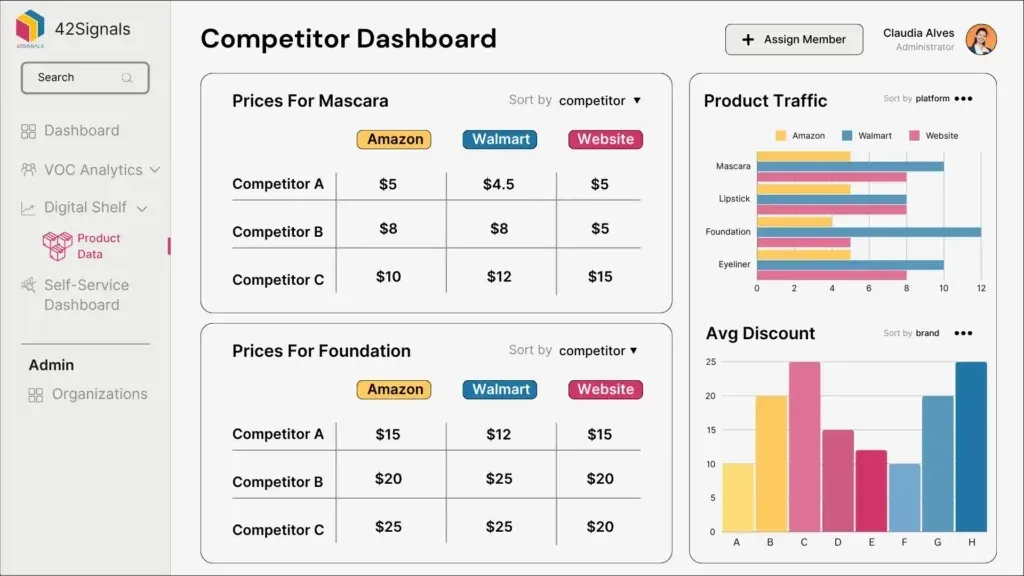
Image Source: 42Signals
Key Data Points to Track for Actionable Insights
Effective pricing intelligence demands tracking specific metrics that reveal profit optimization opportunities. Smart businesses focus on data points that signal market position and customer behavior patterns, moving far beyond basic competitor price monitoring.
Base price vs. promotional price tracking
Base price versus promotional price tracking forms the foundation of accurate pricing analysis. Your base price represents the everyday price point, remaining stable across multiple weeks, while non-promoted price fluctuates more frequently. Base price delivers more reliable benchmarks for long-term pricing strategies compared to non-promoted price, which shifts weekly based on promotional timing.
Non-promoted price serves its own purpose: regular price changes reflect immediately in non-promoted price, while base price requires several weeks to update. Remember that base price differs from average price, which includes all sales regardless of promotional status.
Shipping costs, coupon codes, and bundle offers
Shipping costs directly impact pricing strategy, affecting profit margins and customer purchasing decisions. Maritime freight costs skyrocketed over 600% between October 2020 and October 2021, demonstrating how these expenses can dramatically shift pricing dynamics. When global shipping costs double, headline inflation increases by approximately 0.7 percentage points.
Bundle pricing offers multiple products together at a combined price—typically discounted compared to individual purchases. Businesses implementing product bundling experience an average 30% revenue increase. Well-executed bundles increase perceived value while boosting sales and simplifying purchasing decisions.
Successful bundle pricing requires analysis of:
● Cost of goods sold for each SKU
● Bundle-level discounts
● Shipping and fulfillment costs
● Expected refund rates
Stock availability and out-of-stock alerts
Stock availability monitoring provides strategic advantages often overlooked in pricing intelligence. Retailers incorporating stock availability tracking into pricing strategy achieved 10-15% higher conversion rates compared to those using price monitoring alone.
A European fashion retailer observed competitors consistently running out of popular seasonal items midway through campaigns. Through stock availability intelligence integration, they strategically raised prices during these periods, achieving a 7% revenue uplift. An electronics retailer highlighting “In Stock – Immediate Shipping” during competitor stockouts increased conversions by 20%.
Back-in-stock notifications enhance this strategy by providing valuable insights into specific product demand. These alerts create urgency among interested customers, increasing immediate purchase probability when items return to inventory.
How Pricing Intelligence Tools Work in Real-Time
Modern pricing intelligence tools operate through sophisticated technology that continuously monitors market conditions. These advanced systems turn what was once a manual, error-prone process into an automated, precise operation that delivers actionable insights within minutes rather than days.
Automated data collection using web scraping
Pricing intelligence platforms utilize web scraping technology to extract competitive pricing data directly from competitors’ websites. This automated approach allows retailers to monitor prices from competing e-commerce sites daily or even multiple times per day. Web scrapers send requests to target websites’ servers, fetch HTML content, and then parse specific elements to extract pricing information, promotional offers, and stock availability across thousands of SKUs simultaneously.
Manual data collection becomes virtually impossible when tracking market fluctuations with necessary responsiveness. Manual data entry introduces significant errors, whereas automation reduces these errors by up to 80%, resulting in structured, usable, and consistent data. An automated process works five times faster than manual collection, giving teams greater agility to adapt prices in line with market movements.
Frequency of updates and data accuracy
Pricing intelligence value hinges upon data freshness—outdated information leads to misguided pricing decisions. Modern platforms offer configurable scraping frequency options: daily, weekly, or on-demand, depending on your business challenges and market volatility. Some advanced services refresh data as frequently as hourly, ensuring you work with the most current market view.
Data accuracy remains equally crucial as timeliness. Quality pricing intelligence solutions implement data cleansing that automatically corrects errors, removes duplicates, and fills gaps using advanced statistical methods. These systems employ rotating proxy networks and distributed collection nodes to avoid blocking while gathering accurate regional pricing data.
Integration with eCommerce and ERP platforms
True pricing intelligence power emerges through seamless integration with your existing technology stack. Once configuration completes—product matching, sites to monitor, frequency—the first data becomes available within days, enabling immediate pricing strategy updates. The collected data integrates with in-house tools like ERPs and pricing software, becoming exploitable via clear, personalized dashboards.
Through API and webhook integrations, you receive pricing data and alerts in real-time, allowing updates to flow directly into your systems as they happen. This connectivity enables businesses to implement dynamic pricing strategies that automatically adjust prices across entire catalogs based on competitor activity, inventory levels, and customer behavior patterns. Pricing intelligence fills gaps left by traditional ERP systems by providing real-time market intelligence that allows swift price adjustments in response to market shifts.
Building a Strategy with Intelligent Pricing Platforms
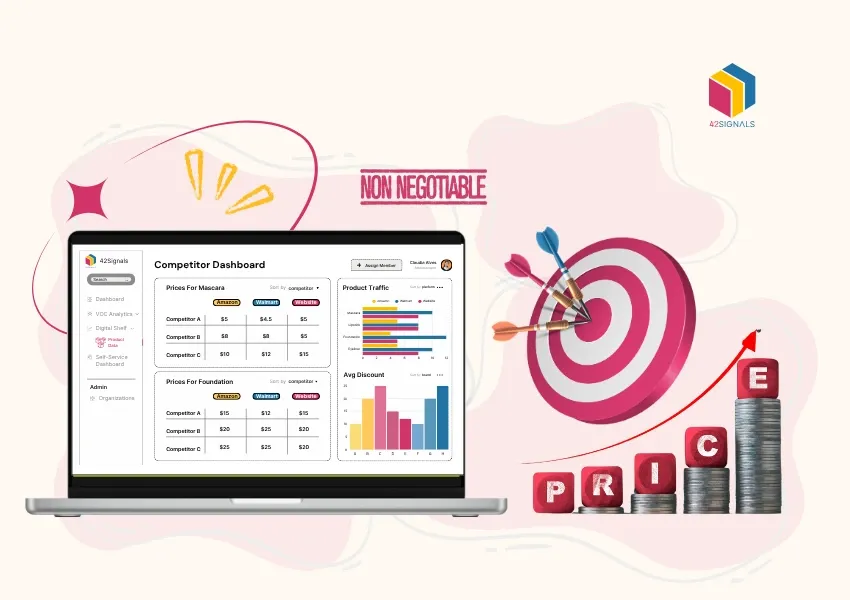
Image Source: 42Signals
Strategic implementation of pricing intelligence creates substantial competitive advantages when properly executed. Businesses using intelligent pricing platforms report 5-10% increases in gross profit while simultaneously improving revenue and customer value perception.
Using pricing intelligence to refine market positioning
Effective market positioning begins with AI-powered insights based on real data, aggregate customer behaviors, and market trends. Advanced analytics give you visibility into how your prices compare across multiple dimensions, allowing you to spot hidden costs and track profits with customized dashboards. This approach enables precise de-averaging of prices—investing strategically in key value items that drive customer store selection rather than applying blanket adjustments.
Opportunities emerge when competitors’ prices sit 20-30% higher than yours, creating space for profitable positioning without sacrificing volume. Smart businesses capitalize on these gaps by:
● Identifying high-impact products that influence customer store selection
● Adjusting pricing on strategic items while maintaining competitive positioning
● Monitoring profit margins across different customer segments
Dynamic pricing rules based on competitor behavior
AI identifies patterns in price trends, customer behavior, and market shifts to guide smarter pricing decisions over time. Organizations already using AI within their pricing strategies cite better scenario planning (25%) and faster decision-making (18%) as primary benefits.
Modern pricing platforms allow you to simulate different pricing scenarios, evaluate potential outcomes, and adjust strategies in real-time to maintain market competitiveness. This capability proves particularly valuable in fast-moving industries where hesitation leaves you trailing behind competitors.
Identifying pricing gaps and customer value thresholds
Understanding price thresholds—points at which further price increases would deter potential buyers—creates strategic advantages. Consumer magnitude perceptions shift significantly when changing the left digit (e.g., USD 3.00 to USD 2.99), with .99 price endings resulting in 8% higher sales volume.
Customer lifetime value metrics help identify pricing sweet spots where willingness to pay aligns with perceived value. Through elasticity monitoring, you can identify the precise thresholds at which perceived value drops, enabling smarter discounting and bundling strategies. These insights allow you to price with confidence, knowing exactly where customer resistance begins and profit optimization peaks.
Choosing the Right Pricing Intelligence Solution
Selecting an effective pricing intelligence solution determines whether market data becomes profit or remains unused information. A Statista survey revealed that 70% of US online shoppers prioritize competitive pricing in their digital purchasing decisions.
Key features to look for in pricing intelligence tools
Successful pricing intelligence tools offer accurate product matching capabilities through AI-based image recognition and similarity matching to deliver a complete competitive picture. Look for solutions that capture various pricing types including bundled pricing, promotional structures, and manufacturer-regulated pricing. The tool must provide real-time monitoring with high data update frequency since pricing data becomes stale quickly.
Evaluating reporting and analytics capabilities
The best pricing intelligence platforms present data at various granularity levels: category, sub-category, brand, and individual product. Value comes from actionable insights—prioritize tools that automatically highlight pricing opportunities requiring immediate attention. Historical pricing analysis capabilities allow you to identify exploitable trends, making this feature indispensable for strategic planning.
Scalability and integration with existing systems
Your pricing intelligence solution must integrate seamlessly with existing technology including CRM and ERP platforms. Proper API connectivity eliminates manual data entry while improving accuracy. A scalable solution that grows with your business saves costs over time—prioritize tools offering increased capacity at reasonable price points.
Ready to discover which pricing intelligence features align best with your specific business objectives? Our free Pricing Pulse Audit determines the optimal solution for your technology stack and growth goals.
Conclusion
Pricing intelligence creates measurable competitive advantages that directly impact your bottom line. Smart pricing decisions separate thriving businesses from those struggling with razor-thin margins or lost market share.
Customer signals constantly reveal opportunities that traditional pricing methods miss entirely. These behavioral patterns—from browsing habits to purchase timing—contain valuable insights about willingness to pay, seasonal demand, and competitive positioning. We help you decode these signals into pricing strategies that respond to market conditions rather than simply react to competitor moves.
Data drives every successful pricing decision. Base prices, promotional structures, shipping costs, and stock availability create the complete picture needed for informed strategy. This approach identifies precise thresholds where customer value perception aligns with profit goals, boosting both conversion rates and margins.
Modern pricing intelligence tools have made sophisticated market analysis accessible to businesses of every size. These platforms collect competitive data automatically, deliver real-time updates, and integrate seamlessly with your existing systems. Dynamic pricing adjustments happen as market conditions evolve, keeping you competitive without constant manual intervention.
Strategic implementation delivers results that matter: businesses report 5-10% increases in gross profit while improving customer value perception. AI-powered insights help you refine market positioning, implement dynamic pricing rules, and identify valuable pricing gaps competitors have overlooked.
Your next step toward pricing excellence starts with understanding your current position. Take our free Pricing Pulse Audit to receive a customized assessment of your pricing strategy and discover specific opportunities for profit growth. The most successful companies recognize that pricing intelligence isn’t about watching competitors—it’s about converting customer signals into sustainable profit advantages that drive long-term success.