
Why AI Ethics in Business Starts With Honest Pricing
AI ethics in business faces a critical reality: 75% of consumers would abandon your company if they found your AI systems treated certain groups unfairly. Customers judge your ethical commitment first through your pricing decisions. Ethical pricing practices can increase revenue by 12-40%, proving that doing right and doing well line up. The ethical considerations of AI extend way beyond compliance, and the ethical issues of AI become clearest in pricing transparency. This piece explores AI ethics examples in pricing, reveals ethical ways to use AI in your pricing models, and shows how AI can be used ethically to build customer trust while maximizing profit.
Why Pricing Is the First Ethical Test for AI Systems
The visibility of pricing decisions
Pricing sits at the intersection where your AI systems meet your customers’ wallets. Backend algorithms process data invisibly, but pricing decisions announce themselves every time someone opens your checkout page or receives a quote. This visibility makes pricing the most inspected AI application in your business.
Transparency in AI-driven pricing operates on three interconnected levels. Model-level transparency gives you the chance to inspect, understand and audit the algorithm’s logic itself. Decision-level transparency discloses the specific factors that influence an individual pricing decision. System-level transparency reveals broader organizational openness about AI adoption and governance.
B2B buyers already show an inherent affinity for algorithmic pricing. Data shows that 77% of consumers are neutral or comfortable with AI being used to boost purchase experiences. More, B2B buyers trust the objectivity and fairness of algorithms, which overcome the typical obfuscation of people negotiating price. Your pricing systems start with a trust advantage that human negotiators lack.
But this trust comes with conditions. Customers need clarity on the factors that influence AI-generated outputs. Pricing decisions must be explainable, not just accurate. When your algorithm adjusts a price, customers expect to understand why. Without this clarity, you transform a trust advantage into a liability.
How customers judge AI ethics through pricing
Your customers evaluate AI ethics in business through two distinct fairness dimensions. Distributive fairness measures the perceived equity of outcomes, while procedural fairness assesses the equity of your decision-making process. Both dimensions shape how customers respond to your pricing.
When consumers find they are charged more than others for the same product, they experience strong feelings of immorality and unfairness. This perception leads to negative emotions, diminished trust in your platform and decreased purchasing intent. More, customers may participate in self-protective actions like spreading negative word-of-mouth or lodging complaints.
The perception of ethical shortcomings in pricing influences consumer relationships with your firm by a lot, potentially diminishing purchase intentions or provoking retaliatory actions. Consumers evaluate fairness not solely based on price levels but on the perceived legitimacy of the decision-making process that produced the price.
High-profile cases ranging from surge pricing during emergencies to algorithmically-driven personalized discounts have drawn public scrutiny to issues of algorithmic opacity and distributive justice. These examples show what the ethical issues of AI in pricing are: the real risk is not higher prices, but hidden, personalized pricing that consumers cannot see or understand.
Algorithmic pricing often operates as a “black box,” where consumers lack visibility into how personal data influences price determination. This opacity challenges traditional assumptions of market fairness because similar products may be offered at different prices without explicit justification. Even when your algorithms operate according to efficiency objectives, the absence of transparency mechanisms creates perceptions of manipulation.
Pricing as a trust gateway
Evidence indicates that consumers are more likely to accept dynamic pricing when they perceive procedural fairness and benevolent intent. Even when the immediate price outcome is unfavorable, transparency and perceived fairness can alleviate negative behavioral responses.
Your pricing decisions serve as the gateway through which customers judge all your AI systems. When you apply AI for pricing, you must address ethical and bias considerations to ensure fairness. This involves auditing and updating algorithms on a regular basis to prevent any collateral damage that may disadvantage certain customer segments.
Without sufficient trust, consumers perceive personalization as exploitative, resulting in reduced engagement, strategic avoidance behaviors or diminished platform loyalty. Trust deteriorates when you fail to communicate data usage practices clearly, especially when personalization relies on sensitive behavioral information.
For entrepreneurial firms, this creates both risk and chance. New ventures rely heavily on legitimacy, so breaches of fairness or transparency in pricing can jeopardize consumer trust and investor confidence. Correspondingly, entrepreneurship also enables agility in applying explainable AI frameworks and models that think about fairness, positioning start-ups as potential leaders in setting standards for responsible pricing practices.
Companies must be able to communicate the factors that influence AI-driven pricing clearly and provide mechanisms for customers to challenge or ask about pricing decisions. By prioritizing fairness considerations, you boost your reputation and customer loyalty while establishing pricing as a foundation for broader ethical AI practices.
Common Ethical Issues of AI in Pricing Models
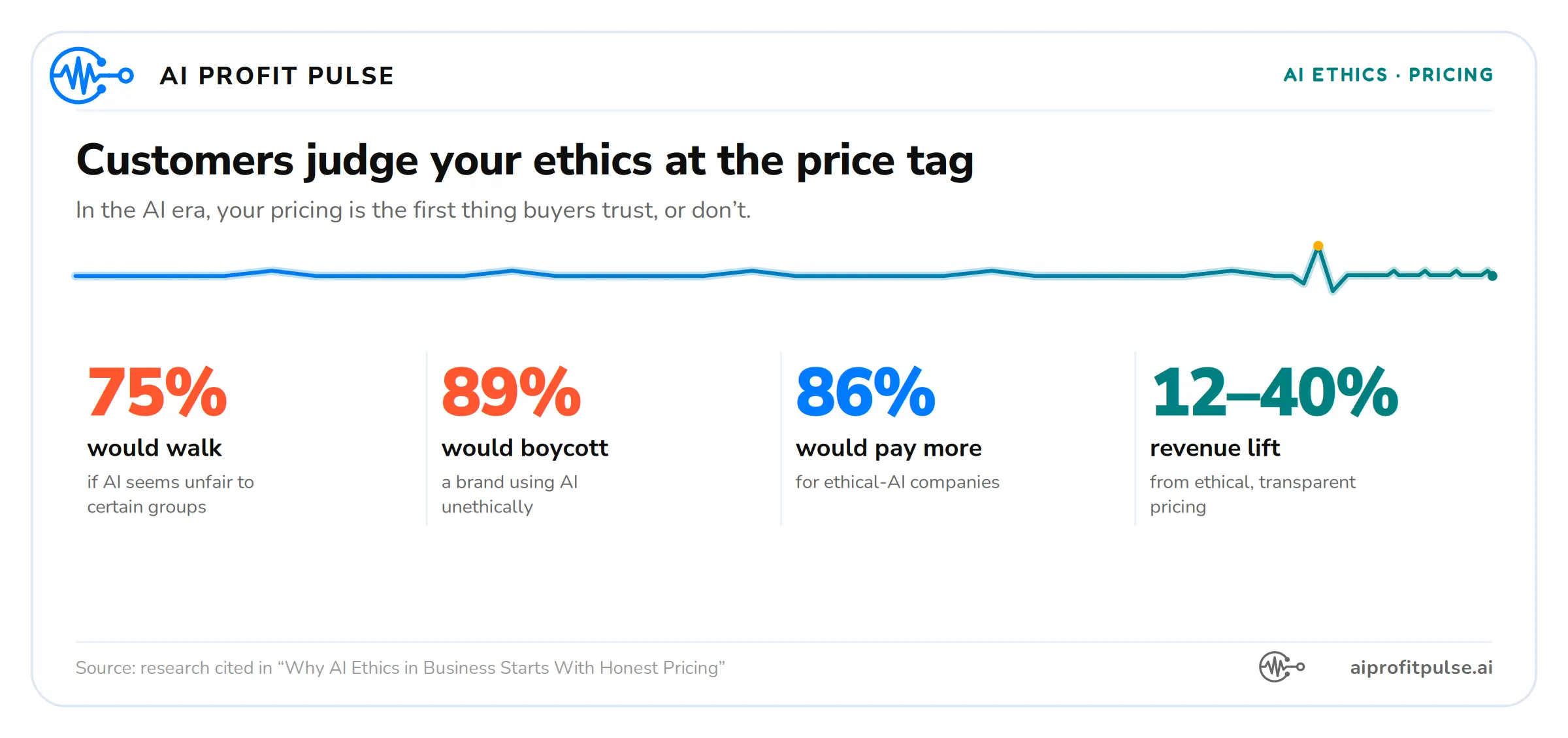
Three distinct ethical violations plague AI pricing systems, and each can destroy customer relationships you’ve spent years building. These aren’t theoretical concerns. Companies right now face regulatory penalties, customer backlash and competitive disadvantage because their pricing algorithms crossed ethical lines.
Hidden price discrimination
A Consumer Report study in December 2025 exposed what your customers fear most: paying more than their neighbor for similar products. Instacart’s pricing algorithms charged Seattle customers up to $10 more for the same basket of groceries. This amounts to around $1200 per year in hidden costs. Instacart paused the technology after the study’s publication.
The problem extends beyond grocery apps. Research reveals that two shoppers buying the exact same item from the exact same store at the exact same time receive different prices, sometimes varying by as much as 20% on a single item. Algorithmic assessments of your willingness to pay based on personal data profiles create these discrepancies.
Protected groups face higher prices. Black individuals, Asians and females may be charged more due to their higher valuations for products, creating disparities against protected classes. This pricing strategy becomes illegal when it discriminates based on race, religion, nationality or gender, violating the Civil Rights Act of 1964 and the Equal Credit Opportunity Act of 1974.
Consumers see the practice as unfair and immoral when they find they paid different prices from others. More, these fairness perceptions depend on culture. An Indian delivery service charges individuals up to 50% more in wealthy neighborhoods with apparent impunity, while similar practices in Western markets trigger outrage and trust erosion.
Lack of transparency in algorithmic pricing
Algorithmic pricing operates as a black box to consumers, policymakers and enforcers who don’t know or understand what information feeds these algorithms. Many consumers remain unaware that personal data determines their pricing, creating a fundamental lack of informed consent. The opacity makes it difficult for consumers to understand or challenge the prices they receive.
This opacity creates legal peril beyond customer relations. Pending lawsuits allege that hotels delegating pricing to shared algorithms colluded to set prices higher than competitive markets would produce. The Department of Justice complaint argues that landlords fed proprietary, nonpublic data into centralized pricing algorithms that recommended rental rates landlords adopted, often on autopilot.
Federal regulators intervened and argued these systems lead to collusion and antitrust violations, even without explicit agreements among parties. The DOJ settled with large landlords who were RealPage customers and required them to stop using the software. Research shows pricing algorithms can learn to collude without illicit communication or hub structures, just through repeated interactions.
The antitrust peril lies less in using firm-specific and observable data, and more in incorporating proprietary, competitor-specific information or centralized algorithms. Companies access competitors’ private, proprietary data and improve their knowing how to forecast demand and anticipate competitors’ actions, setting prices higher than they would otherwise.
Data privacy violations in pricing systems
The major ethical dilemma of algorithmic pricing stems from collecting fine-grained consumer behavior data and the lack of transparency around that collection. Tracking cookies drive personalized pricing models and capture browsing activity including clicks, past page visits and personal information entered on sites. This data segments consumers according to tastes and income to display the most advantageous price for merchants.
Many consumers remain unaware this information is even collected, and merchants don’t just need explicit consent to use tracking cookies for pricing purposes. The FTC has dubbed this practice “surveillance pricing.” Based on documents from six major firms, the FTC found companies using Targeted Pricing Solutions and User Segmentation Solutions that incorporate consumer data like location, purchase and return history, customer service interactions, browsing behavior and demographics to set or personalize prices.
Using personal information to assess maximum willingness to pay violates core principles of valid consent and reasonable purpose under personal data protection law when setting prices. This data collection creates massive informational advantages for companies and offsets any price advantage consumers gain from searching online. The categorizations and classifications enabled by data and machine learning at scale challenge notions of fair pricing practices.
The Real Cost of Dishonest AI Pricing
Unethical pricing decisions generate measurable financial damage that goes way beyond immediate customer complaints. Companies face three distinct categories of costs when their AI pricing systems cross ethical boundaries. Each category can erode your market position and profit margins.
Customer trust erosion
Amazon’s dynamic pricing model drove sales and managed to keep a competitive edge. Yet it faced scrutiny and criticism from consumers who saw pricing practices as neither transparent nor fair. This erosion of trust among consumers forced Amazon to address concerns in public. The company emphasized its commitment to fair pricing practices and took steps to ensure algorithms don’t participate in unfair practices.
The backlash against Ticketmaster proved even more severe. Artists like Bruce Springsteen and Taylor Swift criticized the pricing practices in public. This prompted calls for greater regulation of the ticketing industry and increased scrutiny from both fans and policymakers. When high-profile voices magnify customer frustration, your pricing ethics become headline news.
The financial effect of reputational damage hits harder than most executives think over. Research from the University of California, Berkeley found that a company’s stock price drops an average of 0.93% on the day it becomes embroiled in a scandal. These companies also see a long-term decrease in their stock price of about 12%. The study also found that a company’s stock price takes an average of three years to recover from a scandal.
Reputational damage, customer churn, and exclusion from enterprise contracts can go way beyond the investment required for proper compliance frameworks. More than 70% of surveyed executives admitted they’ve had to pause or completely roll back at least one AI initiative because of ethical, legal, or reputational concerns. Several executives underestimated what it would cost them to fix bias issues and retrain models after facing public criticism or regulatory pressure.
The lesson becomes clear and painful. Broken trust costs far more to fix than building it right from the start. Companies that skipped the early governance work are now spending months to rebuild systems that could have been ethical by design.
Regulatory penalties and legal risks
New York passed the Algorithmic Pricing Disclosure Act in May 2025. The law requires businesses to inform customers when prices are set using customized algorithms. Violations result in civil penalties of $100,000 per violation and injunctive relief. New York Attorney General Letitia James warned businesses of the $1,000 penalty per violation.
California’s response proved even more aggressive. AB 325 prohibits agreements to use or distribute a common pricing algorithm and lowers the pleading standard under the Cartwright Act for certain civil claims. Maximum criminal fines for corporate violators increase from $1 million to $6 million per violation. Top fines for individual violators increase from $250,000 to $1 million per violation. Beyond criminal penalties, the law creates a new civil penalty of up to $1 million for each violation in actions brought by the California Attorney General or county district attorneys.
The Department of Justice filed a proposed settlement in November 2025 against RealPage, Inc., a commercial revenue management software provider for the rental housing industry. This case marked the first time DOJ antitrust enforcers went after algorithmic collusion. The DOJ settled with large landlords who were RealPage customers and required them to stop using the software.
The regulatory wave continues to build. More than 50 bills have been introduced to regulate algorithmic pricing across 24 state legislatures in 2025 alone. This legislative momentum shows no signs of slowing as lawmakers attempt to catch up to technology that changes faster.
Competitive disadvantage in ethical markets
Consumer behavior data reveals that ethical AI practices directly influence purchasing decisions and brand loyalty. A survey of 1,000 consumers in the United States, the UK, and Germany found that 86% said they would be willing to pay more for products and services from companies that are committed to ethical AI practices. Furthermore, 89% said they would boycott a company if it was revealed to be using AI unethically.
The competitive advantage flows to companies that prioritize governance from the start. Companies with clear accountability models and bias testing protocols were twice as likely to report financial gains from their AI innovation. Businesses that implement AI without meaningful user consent create legal and ethical friction that threatens long-term sustainability.
Trust has become the most valuable asset of all. Users, regulators, and enterprise customers increasingly review technology choices through the lens of governance, accountability, and ethical considerations. Organizations that implement robust AI governance frameworks demonstrate to customers and partners that they take their responsibilities seriously.
Companies that fail to recognize this move risk finding themselves excluded from markets where trust and compliance are prerequisites. The pursuit of profits should not come at the expense of customer trust or well-being, especially during times of crisis or in markets where consumers are vulnerable.
What Honest AI Pricing Actually Means
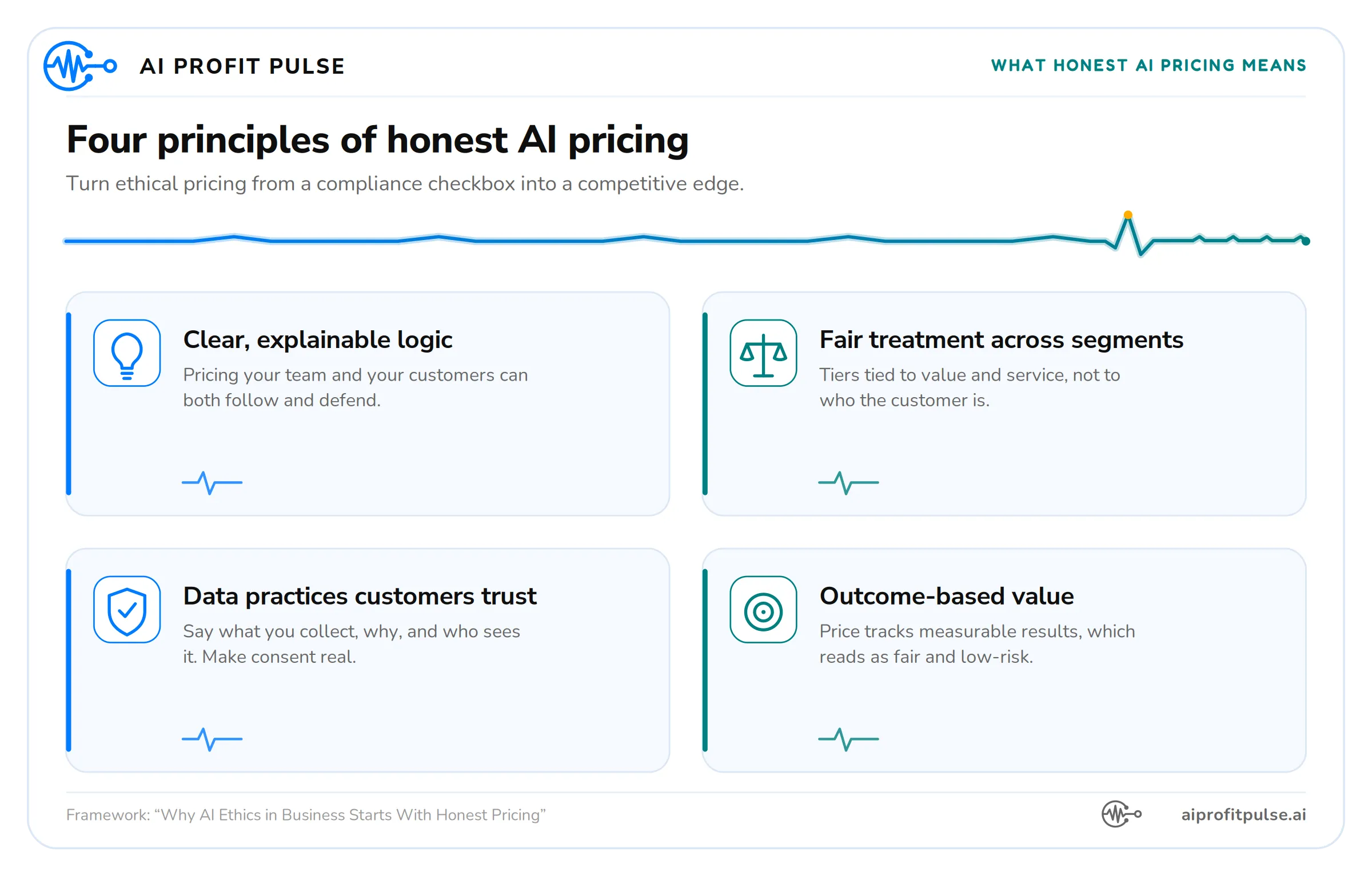
Honest AI pricing changes ethical considerations of AI from compliance checkbox into competitive advantage. Four interconnected principles define this approach. Each builds trust while protecting profit margins.
Clear pricing logic and explainability
Your pricing systems must meet explainable AI standards that sales teams and customers can both understand. The NIST framework for explainable AI outlines four key principles that apply to pricing algorithms: Explanation, Meaningfulness, Explanation Accuracy, and Knowledge Limits.
Your sales team can’t defend AI-driven pricing if it can’t explain its decisions. This becomes a business risk when market shifts happen faster than AI models can adapt and regulators demand explainability. Pricing logic should be clear, explainable, and defensible.
Advanced pricing solutions now provide strategy explanation features that show the logic behind price adjustments. To cite an instance, elasticity analysis might suggest a price decrease to a specific amount. Then a minimum margin rule increases that price to preserve required margins. A price change cap adjustment modifies the final price because it doesn’t allow changes bigger than a set percentage. This transparency gives pricing teams the ability to justify every AI-driven price.
Fair treatment across customer segments
Segmentation-driven pricing is different from discrimination. Fair segmentation connects economic logic to observable attributes like industry application, company size, value profile, and buying behavior. Price tiers represent differentiated offers lined up to these segments, with clear price fences that justify different prices based on volume commitments, service levels, delivery requirements, or feature sets.
Regular audits for bias using diverse datasets prevent discriminatory outcomes. Guardrails that set minimum thresholds for underserved markets make sure pricing models don’t affect certain customer segments disproportionately. Value-based pricing approaches line up price with outcomes rather than customer characteristics.
Data practices customers can trust
Transparency in data practices requires explaining what information is collected, the specific purposes it will be used for, and who will have access to it. This gives customers the ability to make informed decisions and encourages trust.
Organizations should limit training data collection to what can be collected lawfully and used consistent with the expectations of people whose data is collected. Data minimization combined with clear timelines for data retention demonstrates respect for customer privacy. Mechanisms for consent, access, and control over data change privacy from legal obligation into trust asset.
Outcome-based value alignment
Outcome-based pricing makes sure both parties are invested in achieving success. This builds trust and loyalty. Customers pay for tangible results like increased revenue or reduced costs instead of paying for access. The math becomes easy to defend in budget meetings when cost rises only as results improve.
This model lines up with customers’ willingness to pay because it links price to clear, measurable results. Customers notice outcome-based pricing as fairer and more transparent. They often accept higher prices in exchange for reduced risk.
How to Build Ethical AI Pricing Systems
Building ethical AI pricing requires systematic implementation across four operational areas. These steps transform principles into practical systems that withstand regulatory scrutiny and maintain customer trust.
Audit your data for bias
Your pricing algorithms inherit the biases present in training data. Historical bias exists when past data reflects discriminatory patterns. Sample bias occurs when your dataset skews toward certain groups or remains too small to identify accurate patterns. Measurement bias arises from how data was collected or stored, including systematic recording errors.
Check whether your dataset represents all customer segments in proportion. Collect additional data for those segments if underrepresented groups exist. Establish guidelines for data labeling that alleviate subjective bias from individuals. Apply pre-processing methods to transform original data before you feed it into algorithms.
Design transparent pricing algorithms
Policymakers now require businesses to disclose when prices result from algorithmic decisions. Use white box algorithms that remain explainable rather than opaque black box systems, according to industry best practices. Your pricing logic should be defensible to both customers and enforcement agencies.
Businesses should maintain records of information that feeds pricing algorithms and the decisions those algorithms make. These records must be producible after enforcement requests. Regulators can create adverse inferences of anticompetitive schemes without proper documentation.
Set up monitoring and review processes
Human oversight is essential even with AI handling pricing complexity. Train internal teams on how AI systems generate recommendations. Focus on monitoring outputs and interpreting insights. Give teams the ability to identify anomalies such as unusually low or high price recommendations.
Create governance frameworks with policies that govern pricing strategies and ensure compliance with anti-price gouging regulations. These frameworks should align with brand positioning. Assign specific roles like pricing managers or data stewards to oversee system performance and data integrity.
Communicate pricing decisions clearly
Customers must understand and accept reasons for price fluctuations as demand changes. Clear communication about dynamic pricing strategies prevents customers from perceiving changes as unfair. Make customers aware of your pricing approach, like in airline and hotel bookings where buyers understand demand-based adjustments.
Wondering where AI-powered pricing could strengthen your revenue model? Take the free Pricing Pulse Audit to identify hidden opportunities in your current pricing structure and ensure your approach aligns with ethical AI standards.
Ethical Considerations of AI Beyond Pricing
The principles governing ethical AI pricing extend naturally to every AI system your organization deploys. Pricing serves as the most visible test case for broader governance challenges that affect hiring algorithms, credit decisions, supply chain optimization and customer service automation.
Applying pricing ethics to other AI systems
AI governance covers policies, procedures and ethical considerations required to oversee development, deployment and maintenance of all AI systems. Five core principles are the foundations of this framework: fairness prevents discrimination and bias in automated decisions, transparency ensures stakeholders understand how systems operate, accountability assigns clear responsibility for AI outcomes, privacy protects sensitive data throughout the AI lifecycle, and security defends against vulnerabilities and cyber threats.
Training data, feature selection or deployment context can introduce bias. This leads to disparate outcomes in different populations. Governance programs should require teams to assess fairness risks early and document known limitations. They must monitor for collateral bias as models evolve in production.
Building company-wide AI governance
AI governance that works demands a collaborative effort. Organizations should assemble small groups including legal, compliance, privacy, security and AI practitioners rather than relying on ad hoc updates. Many teams use a centralized-federated model. A central group defines standards, risk frameworks and policies while domain teams apply them locally and remain accountable for outcomes.
Create an AI ethics and compliance committee with representatives from technology, legal, risk management and leadership. This committee can define review processes for new AI developments and establish training programs. The most successful programs make responsible AI everyone’s responsibility, not just a compliance function.
Training teams on ethical AI practices
Regular training sessions educate employees about their roles and responsibilities in AI governance. Awareness programs help reinforce the importance of accountability and ethical practices in AI development. Train internal teams on how AI systems generate recommendations and emphasize the importance of monitoring outputs and interpreting insights.
An effective AI compliance team should include specific roles: Chief AI Ethics Officer, AI Compliance Manager, Legal Counsel, Data Protection Officer, AI Risk Manager and Technical AI Experts. Each role carries distinct responsibilities that maintain ethical standards across your AI portfolio.
Conclusion
AI ethics in business starts with honest pricing because customers judge your ethical commitment through this single touchpoint. Your pricing decisions create either trust or suspicion that colors every interaction afterward. Companies that build transparent and fair pricing systems avoid regulatory penalties and reputational damage while tapping into competitive advantages through customer loyalty and premium positioning. The framework outlined here applies to your AI portfolio, from hiring algorithms to customer service automation. Ethical AI isn’t a compliance burden. It’s a profit driver that separates market leaders from those scrambling to recover from avoidable scandals. Ready to line up your pricing with both ethics and profitability? Take the free Pricing Pulse Audit and identify where AI-powered pricing strategies can uncover hidden revenue opportunities in your current structure.
For weekly insights on AI pricing strategy and decision frameworks for leaders, subscribe to the AI Profit Pulse newsletter.