
Building Seasonal Pricing Models With AI
Your busiest weeks decide your year. In the United States, holiday retail sales crossed $1 trillion for the first time in 2025, growing 4.1 percent over the prior season. That concentration cuts both ways. Price your peak well and it carries the year. Price it from last year’s spreadsheet and you will never notice the margin you left behind, because the volume hides it.
Seasonal demand is one of the few things in business that is genuinely predictable. It repeats, it leaves a data trail, and it rewards preparation. This piece is about turning that predictability into a pricing model instead of a guess. If you want a fast read on where your current pricing leaks margin before your next peak, take the Pricing Pulse Audit, a short, evidence-based review of your pricing strategy.
Why does last year’s price list stop working?
Because a seasonal price built on habit encodes last year’s conditions, not this year’s.
Most seasonal pricing is a copy-paste job. You open last year’s file, adjust for inflation, and run it back. That approach silently assumes your costs moved the way you guessed, your competitors held still, and demand will arrive on the same days it did last year. In a peak period, all three assumptions get tested at once, and you find out you were wrong when the season is already half over.
The cost of being wrong is bigger than it looks. Static prices are a slow leak: costs move, demand moves, competitors move, and a fixed price absorbs all of it. McKinsey’s retail research puts disciplined dynamic pricing at roughly 2 to 5 percent sales growth and 5 to 10 percent margin improvement against static pricing, with pilot categories showing up to 3 percent gains in both at once. Those are not transformational numbers, and I would be suspicious of anyone promising more. But applied to the weeks that carry your year, a few points of margin is real money.
What does a seasonal pricing model actually contain?
Not a single price. A set of rules that decide the price as conditions change.
A usable model has four parts. First, a demand curve for the season, built from your own history rather than intuition, showing when demand climbs, peaks, and falls. Second, your cost floor for each item, so no rule can ever price below it. Third, the levers you will actually pull, an opening price, planned step changes, and a markdown path for what does not sell. Fourth, guardrails, the maximum you will move a price and how often, so the model cannot do something you would never approve.
This is where AI genuinely helps, and it is worth being precise about how. It does not invent demand. It finds structure in the signals you already have but never combine in one place: your own sales history by week, competitor movements, search interest, weather, and the calendar shifts that move a season by a few days each year. McKinsey’s operations research puts AI-driven forecasting at a 20 to 50 percent reduction in forecast error versus traditional methods. A better forecast is the foundation of a better seasonal price, because everything downstream depends on knowing when demand actually arrives.
If you want the mechanics of how those models work, our guide to how predictive analytics actually forecast prices and demand goes under the hood.
How do you build one before your next peak?
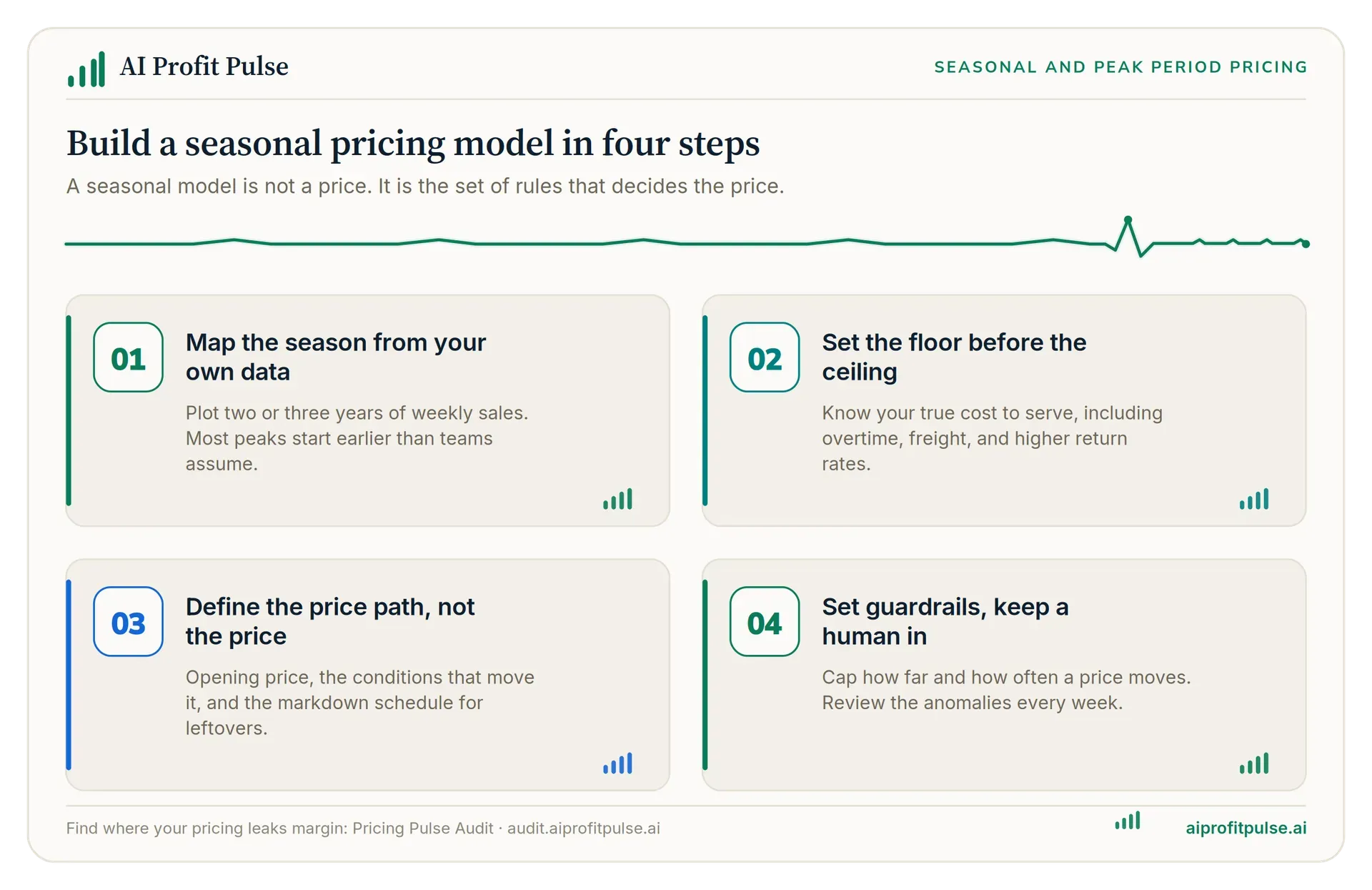
Four steps, in this order, and the order matters.
Map the season from your own data. Pull two or three years of weekly sales and plot when demand actually rose and fell, not when you assumed it did. Most businesses discover their peak starts earlier and tapers differently than they believed. That single correction is often worth more than any pricing sophistication layered on top.
Set the floor before the ceiling. Know your true cost to serve for each item, including the seasonal costs people forget: overtime, expedited freight, higher return rates. The floor is what keeps a busy season from being a profitable-looking, cash-losing one.
Define the price path, not the price. Decide the opening price, the conditions under which it moves, and the markdown schedule for leftovers. Writing the rules in advance is what stops panic discounting in week three, which is where most seasonal margin dies.
Set guardrails and keep a human in the loop. Cap how far and how often a price can move, and have someone review anomalies. This is also a trust issue, not just a control issue. Gartner found that 68 percent of consumers feel taken advantage of by dynamic pricing when it happens without explanation, so the model should make your pricing more defensible, not more opaque.
Where seasonal models go wrong
Three failure modes account for most of the damage.
Optimizing for volume instead of margin. A model tuned to move units will happily sell your whole peak at a price that never recovers your cost to serve. Judge every rule on contribution, not revenue.
Treating the model as autopilot. The season you are pricing is not identical to the seasons you trained on. Weather, competitors, and calendars shift. Review weekly and be willing to override.
Forgetting the customer remembers. Prices that swing without explanation during your busiest weeks are seen by the largest audience you will have all year. Whatever your model does, you should be able to explain it in one plain sentence. Our piece on making dynamic pricing work fairly covers how to keep that credibility intact.
The takeaway
Seasonal demand is predictable, which makes seasonal pricing one of the few places where preparation reliably beats reaction. Build the model from your own demand history, set a real cost floor, define the price path and the guardrails before the rush, and keep a person watching. Given that peak weeks concentrate so much of the year’s revenue, and that disciplined dynamic pricing is worth roughly 5 to 10 points of margin, the work you do now is the highest-leverage pricing work available to you.
Ready to find the gaps before your next peak? Take the free Pricing Pulse Audit and see where your pricing is quietly leaving money behind. For the launch-side companion to this piece, see pricing new products with AI-enabled insights.