
Pricing New Products With AI-Enabled Insights
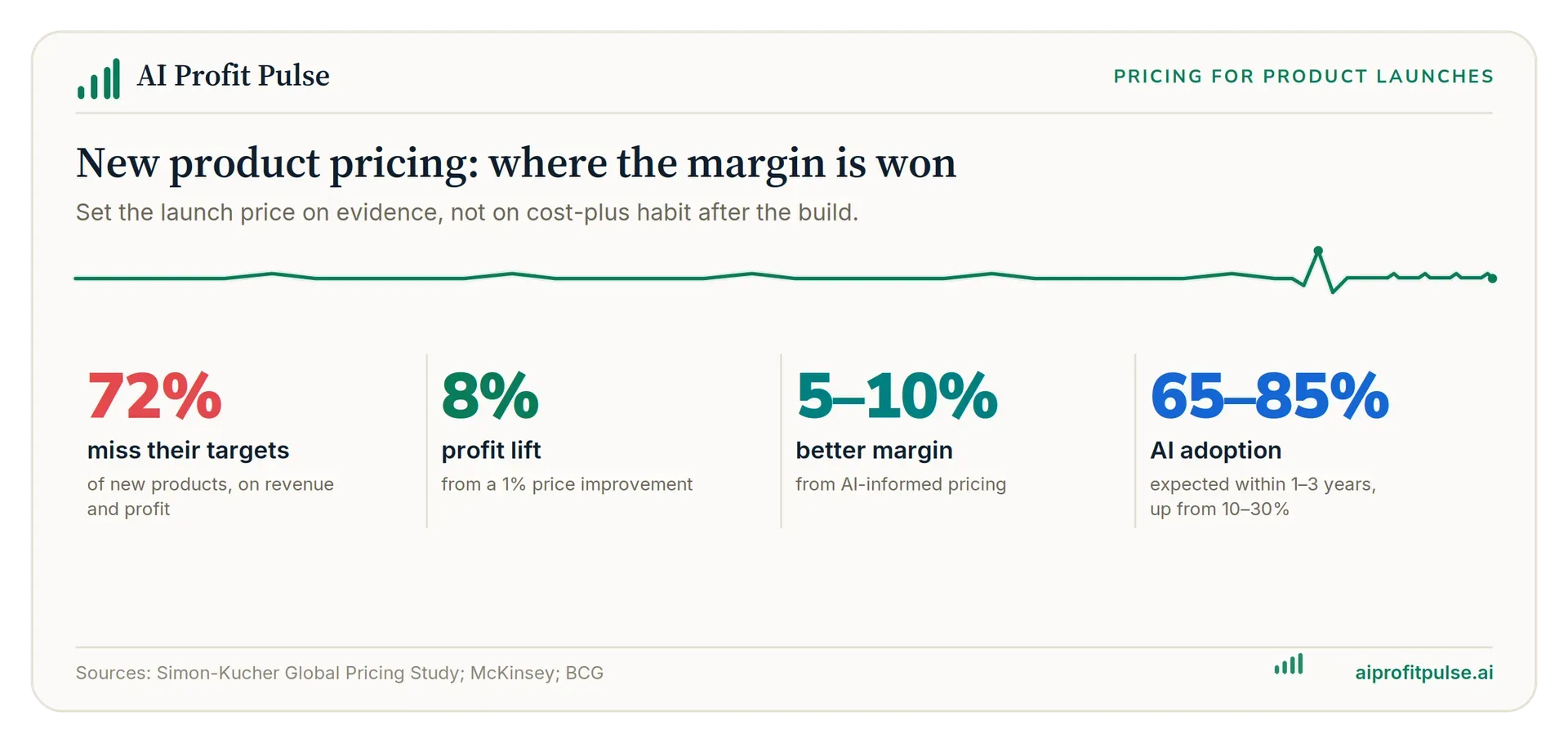
Most new products do not fail because the idea was weak. They fail because the price was an afterthought. Simon-Kucher’s global pricing research, the largest study of its kind, has found for years that 72 percent of new products miss their revenue and profit targets. The single trait that separates the winners is not a bigger budget. It is that they have the willingness-to-pay conversation early, using evidence, instead of pricing on cost-plus habit at the end.
That is exactly where AI-enabled insight earns its place. Before you launch, you can turn scattered market signals into an evidence-based read on what buyers will actually pay, and price the product on that, not on a guess. If you want a fast, no-obligation read on where your current pricing is leaving money on the table, take the Pricing Pulse Audit, a short, evidence-based review of your pricing strategy.
Why do most new products miss their numbers?
Two mistakes show up again and again, and both are curable.
The first is sequence. In most launches, pricing is the last decision, made once the product is already built. By then the team has added features nobody weighed against willingness to pay, and the price gets set on cost-plus or on whatever the old product charged. Simon-Kucher’s researchers describe the pattern plainly: companies rarely factor in what customers will pay during development, so the price ends up reflecting internal cost and history rather than value.
The second is that the stakes are widely underestimated. Pricing is the fastest profit lever you have. McKinsey’s classic analysis of the S&P 1500 found that a 1 percent improvement in price lifts operating profit by roughly 8 percent, assuming volume holds. That is a larger swing than a 1 percent cut in costs or a 1 percent rise in volume. On a launch, where you are setting the anchor customers will remember, a small pricing error compounds for the life of the product.
Put those together and the picture is clear. You are making your highest-leverage decision last, with the least evidence. AI-enabled insight flips the order.
What does “AI-enabled” actually add to launch pricing?
Strip away the hype and AI does one useful thing here: it turns messy, high-volume signals into a defensible estimate of willingness to pay, fast enough to use before launch.
Concretely, that means three capabilities.
You can estimate willingness to pay from real behavior, not just surveys. Models trained on transaction data, competitor prices, feature comparisons, and search and review language give you a value-based starting point instead of a cost-plus one. If you want the mechanics, we broke down the hidden math behind willingness-to-pay analysis and what the data really shows.
You can segment before you set a number. The same product rarely has one price. AI helps you see which buyer groups value which outcomes, so you can design tiers and price fences that fit real demand rather than a single blended guess.
You can run scenarios cheaply. Instead of betting the launch on one price, you can model how demand and margin respond across a range, and walk in with a defended recommendation.
The payoff is measurable, though smaller than vendors claim. McKinsey and BCG benchmarks put AI-informed pricing at roughly 2 to 5 percent higher revenue and 5 to 10 percent better margin against tested categories, not the plus-40 percent you sometimes see in a case study. This is also where the market is heading. In a November 2025 McKinsey survey of 419 B2B pricing leaders, current AI-in-pricing adoption sat between 10 and 30 percent, and those same leaders expected it to reach 65 to 85 percent within one to three years. Pricing your launches on evidence is becoming table stakes, and right now it is still an edge.
One honest caveat. AI here is decision support, not autopilot. It sharpens the estimate you bring to the table. A human still owns the call, the segments, and the story you tell customers. If you are weighing tools, our guide to evaluating AI pricing tools for better ROI will save you a few expensive detours.
How do you price a new product with AI insight, step by step?
You do not need a data-science team to start. You need the right sequence.
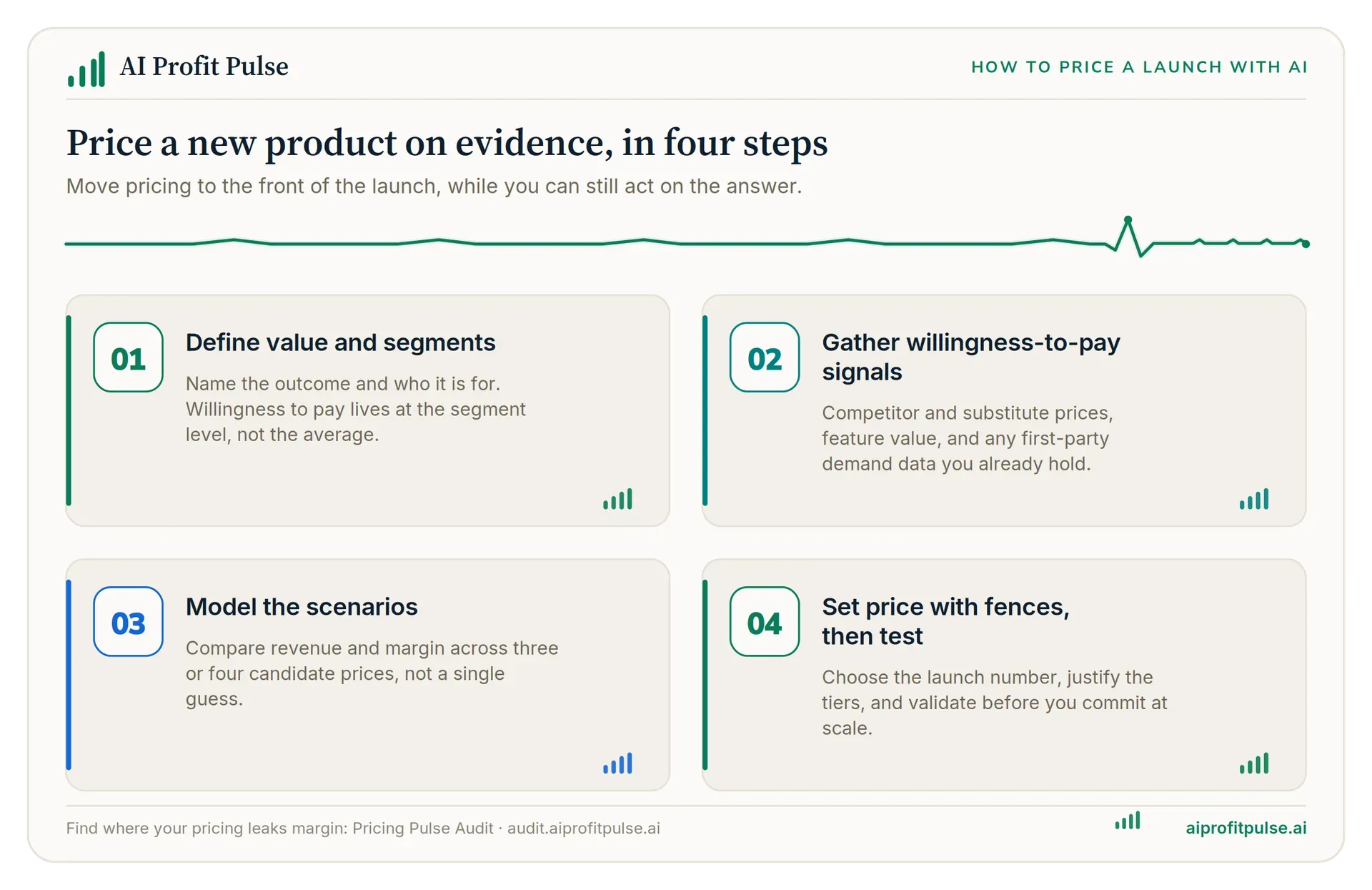
Define the value and the segments first. Name the specific outcome your product delivers and for whom. Willingness to pay lives at the segment level, so resist the urge to find one price for everyone.
Gather willingness-to-pay signals. Pull competitor and substitute prices, feature-value comparisons, and any first-party demand data you have. Let the model turn that into a value-based range, then sanity-check it against what you know.
Model the scenarios. Look at how revenue and margin move across three or four candidate prices, not one. Choose the launch price that best balances adoption and profit for your priority segment.
Set the price with fences, then plan to test. Pick your launch number, define the tiers and rules that justify different prices, and treat the number as a hypothesis, not a verdict. The strongest teams validate before they commit at scale. We wrote a full playbook on how to run pricing experiments without killing your revenue, which is the natural next step after this one.
For a launch-specific walkthrough, our guide to setting the right pricing strategy for a new product launch pairs well with the steps above.
Where do teams still go wrong?
Three failure modes are worth naming, because avoiding them is most of the win.
They over-trust the output. A model that optimizes for revenue alone can quietly erode margin or fairness. Keep a human in the loop and check the recommendation against your own judgment before it ships.
They ignore trust. Evidence-based pricing is not permission to price opaquely. Gartner research from October 2024 found that 68 percent of consumers feel taken advantage of by dynamic pricing. The insight should make your price more defensible to customers, not more hidden from them.
They skip the willingness-to-pay conversation. This is the one habit the winning 28 percent share. If AI does nothing else for your next launch, let it force that conversation to happen early, when you can still act on the answer.
The takeaway
New product pricing fails when it is set last, on cost-plus, by guesswork. AI-enabled insight fixes the sequence. It puts an evidence-based read on willingness to pay in front of you before launch, lets you price by segment, and lets you test scenarios instead of betting on one number. Given that a 1 percent price move is worth roughly 8 percent in profit, that shift is not a nice-to-have. It is the difference between joining the 72 percent that miss and the 28 percent that do not.
Want to know where your current pricing is quietly leaking margin before your next launch? Take the Pricing Pulse Audit. It is short, evidence-based, and built to show you the gaps you can close first.