
Why Your Elasticity Model is Wrong: Hidden Pricing Insights for 2025
A small 1% price increase can boost US firms’ operating profits by 8.7%, assuming sales volume stays constant. Your elasticity model plays a crucial role in determining whether such increases will benefit or harm your profits.
Gartner’s research shows that companies using proper price elasticity analysis for their AI solutions earn 10-15% higher margins compared to those using only cost-plus or competitor-based pricing. Many businesses still use outdated price elasticity models that can’t handle today’s complex and fast-changing market dynamics.
Traditional price elasticity modeling struggles with big datasets and shifting consumer behaviors. AI-powered solutions now provide a game-changing alternative. These advanced machine learning tools analyze sales history, customer patterns, and market trends to spot key factors affecting price elasticity. Companies using value-based pricing for AI services see 25% higher profit margins than those relying on cost-plus methods.
Current price elasticity modeling helps businesses adapt to market changes. Choosing the right approach means understanding both traditional models’ limits and AI-powered alternatives’ capabilities. This piece explains why your existing elasticity model might hurt your pricing strategy and shows how to use AI tools to boost profits in 2025 and beyond.
Why Traditional Price Elasticity Models Fail in 2025
The complex marketplace of today has made traditional pricing theories from Economics 101 outdated. The simple contours that “an x-percent increase in price leads to a y-percent decrease in sales volume” no longer capture the complex relationship between price changes and customer behavior.
Overreliance on Cost-Plus and Competitor-Based Pricing
Organizations still rely on outdated pricing foundations. Cost-plus pricing adds a markup to production costs and remains popular among businesses of all sizes because it’s simple. Notwithstanding that, this approach has major drawbacks:
-
It fails to consider market demand and what customers will pay
-
Market conditions can’t be adapted quickly
-
Products with high perceived value get undervalued, missing revenue opportunities
Competitor-based pricing also comes with big risks. Companies that set prices by copying competitors assume these competitors made the right choice after long decision processes. This makes entire industries lose touch with real demand. Copying competitors’ prices results in many wrong decisions and lost profits, especially when you have competitors making pricing mistakes that spread through the industry.
Companies that analyze price elasticity properly for their AI solutions achieve 10-15% higher margins than those who just use cost-plus or competitor-based pricing.
Ignoring Feature-Level Elasticity in AI Services
Modern elasticity modeling needs detailed data that traditional models can’t provide. Companies might calculate elasticities only at broad category levels without detailed data—an approach that doesn’t work anymore.
Time-based elasticity changes are crucial for AI services, but conventional models often miss this factor. Research shows price elasticity for AI services typically decreases by 15-20% annually as technologies become mainstream. Different capabilities within the same AI service show varying elasticities—premium features are nowhere near as sensitive as commodity features.
Channel differences make elasticity modeling more complex. A SKU might be inelastic in traditional trade but highly elastic in online channels where price comparison is easy. Using the same elasticity assumptions across channels will result in pricing errors.
Static Elasticity Assumptions in Dynamic Markets
The classical elasticity model has “snapped” for four key reasons:
The precise sales effect of price changes remains unclear. Models with price elasticity ratios might predict volume changes without explaining the actual mechanisms—they miss new customer acquisition, changes in purchase frequency, or how different segments respond.
Relative prices matter more than price changes in many categories. Elasticity calculations become meaningless because customers buy from the lowest-priced brand, whatever the price change from previous periods.
The retailer-manufacturer relationship complicates traditional models. When CPG manufacturers cut prices, retail chains just need their cash margin to stay unchanged—manufacturers bear the entire cost.
There’s another reason - “pure price” doesn’t exist in today’s market. Prices include delivery minimums, loyalty incentives, consumer perceptions, and competitive positioning. Accurate estimates become harder with variables like seasonality, promotional investments, retailer merchandising support, and competitor actions.
Machine learning offers flexible pricing capabilities that work better than static elasticity assumptions. Boston Consulting Group reports that companies using ML-driven dynamic pricing for AI services see revenue increases of 5-10%.
Modernizing Your Elasticity Model with Machine Learning
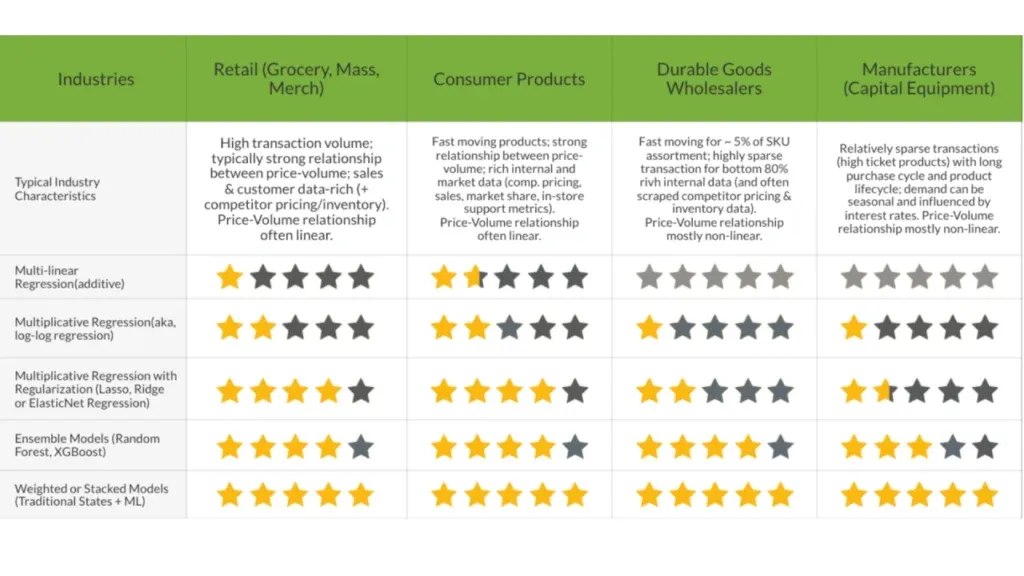
Image Source: LinkedIn
AI and machine learning methods work better than traditional elasticity modeling techniques. Companies in every industry now use these powerful tools to optimize prices more accurately than older methods.
Gradient Boosting for Seasonal Demand Patterns
Gradient boosting machines are great at spotting complex seasonal patterns in pricing data. These algorithms have become popular in forecasting because they can spot non-linear relationships between variables and handle huge amounts of data. You’ll need at least 18 months of transaction history to analyze seasonal demand properly.
What makes gradient boosting so useful for elasticity modeling is how well it handles external variables along with autoregressive ones. These external factors—like day of week, holidays, or economic indicators—can change price sensitivity patterns a lot. The algorithm processes these variables to create detailed elasticity models that adjust to market changes.
XGBoost works really well for elasticity calculations with complex seasonality. It also makes it easy to verify models through backtesting or time series cross-validation. This helps avoid problems with traditional cross-validation methods that don’t work well with time-dependent data.
Neural Networks for Long-Term Price Optimization
Neural networks offer the best way to forecast price elasticity trends for long-term pricing strategies. These systems need lots of historical data—usually 24+ months of detailed sales records—to give reliable results. Once trained, they can process huge amounts of structured and unstructured data to suggest dynamic pricing changes.
Neural networks beat traditional elasticity approaches in several ways:
-
They find hidden links between pricing factors that other models miss
-
They adjust to changing market conditions as they happen
-
They work with many types of data including sentiment and seasonal patterns
These networks are also better at understanding complex customer behavior patterns at the transaction level instead of broad price groups. Companies that use neural networks for price optimization saw their margins grow by 2-7% in the first year. Unlike models based on segmentation that need constant manual updates, neural networks adjust pricing based on live data with less human oversight.
Double Machine Learning for Causal Inference
Double Machine Learning (DML) breaks new ground in accurate price elasticity estimation. It solves a basic problem: finding real cause-and-effect relationships among confusing variables. Regular elasticity models and basic machine learning methods often show bias when estimating causal effects.
DML fixes this through orthogonalization, which relates to the Frisch-Waugh-Lovell theorem in econometrics. The process has three main steps:
-
The outcome model predicts sales using covariates
-
The treatment model predicts price using covariates
-
The outcome residuals are compared to treatment residuals to find the causal effect
This method works great when prices and sales affect each other (the endogeneity problem). DML uses cross-fitting to produce unbiased estimates that are approximately Gaussian and meet the best statistical rates.
Tests show that DML with XGBoost works better than both Two-Stage Least Squares and Ordinary Least Squares methods for elasticity estimation. It gets much closer to the true causal effect. This makes DML reliable for dynamic pricing where confounding relationships get complicated.
Take our free profit pulse audit to see how machine learning can optimize your elasticity model.
Your specific business needs and available data will determine the best approach. Random Forest algorithms might be enough for short-term predictions if you have limited historical data (12+ months), but they don’t do as much as the advanced methods we’ve covered.
Preparing High-Quality Data for Elasticity Modeling
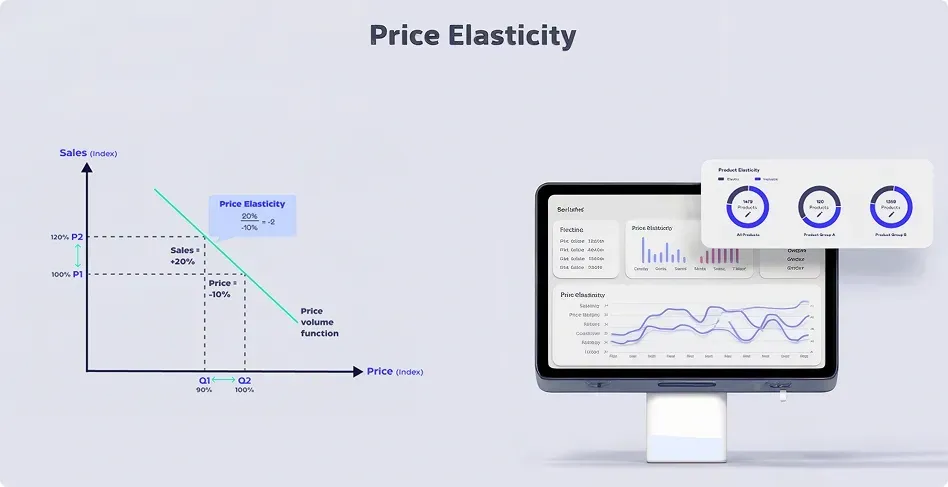
Image Source: Symson
Quality data forms the foundation of any accurate elasticity model. Your pricing strategy can suffer serious damage when price elasticity machine learning algorithms work with poor data preparation.
Sales Transaction Data: Quantity, Price, and Timestamps
You will need complete sales data that has exact quantities sold, pricing points, and detailed timestamps to build effective elasticity models. Here’s what you should have:
-
Complete transaction records that show actual purchases in response to price changes
-
Data from multiple sources like sales records, customer transactions, and market reports
-
Clear timeframe data that captures day-specific price sensitivity patterns
Each product should have direct quantity reporting, and zero-quantity periods need careful handling in your dataset. Nielsen data analysis shows these zero-quantity periods happened in just 0.32% of cases. Price data needs extra attention because it comes from calculations rather than direct reports—you’ll typically get it by dividing revenue by units sold at granular levels.
Historical Pricing and Promotion Records
You’ll need substantial historical pricing data to calculate elasticity accurately. Retailers should have at least two years of pricing and sales history before they start calculating elasticity. The historical data should have:
-
Price variations, because static prices lead to unreliable results
-
Records of promotional activities and their timing
-
Different price points for various customer segments where applicable
Data variation matters as much as history length. You can get this variation through SKU cost changes, promotional activities, different price lists for customer groups of all types, or regular price adjustments.
Market Context: Competitor Prices and Seasonal Trends
The right context helps interpret elasticity patterns. You’ll want:
-
Competitor pricing information with matched products
-
Seasonal demand changes that affect elasticity throughout the year
-
External factors like economic indicators (county-level unemployment rate data)
Seasonal changes in elasticity can be dramatic. Christmas trees become highly elastic from November through December 24th, then drop to zero elasticity right after. Ice cream shows higher elasticity in summer while soup responds better to winter promotions.
Data Cleaning: Outlier Removal and Format Standardization
Data preparation matters before modeling starts:
You should verify all data by removing inaccuracies, duplicates, gaps, and standardizing measurement units. The 3-sigma rule works as a standard approach for outliers—data points beyond three standard deviations from the mean usually count as outliers.
You might remove outliers because of measurement errors, data entry mistakes, or samples outside your target population. Make sure to document any excluded data points with specific reasons, or run analysis both with and without these observations to see the differences.
Your chosen modeling tool will work better when you structure the data in an easy-to-process format.
Segment-Specific Elasticity Modeling and Strategy
Price segmentation helps capture value from customer groups that pay different amounts for the same product. A good grasp of these subtle differences between segments makes elasticity modeling work better.
SKU-Level Elasticity in Online vs Offline Channels
Online and offline prices match about 72% of the time, contrary to common beliefs. The price differences, when they exist, are minimal with online markups averaging just -1%. People who shop online tend to become more price-conscious during their store visits, especially with products that are easy to switch between.
Customer Segmentation Based on Price Sensitivity
K-means clustering analysis shows three main customer groups with different attitudes toward pricing:
-
Price-sensitive customers make up the biggest group and look for cheaper options
-
Balanced customers buy more mid-priced items
-
Quality-focused customers gladly pay extra for products they see as valuable
Take our free profit pulse audit to find your segment-specific elasticity opportunities.
Channel-Based Elasticity Differences
Each channel’s elasticity changes based on its format and value offering. Studies show that different pricing across channels boosts perceived value but also makes customers feel prices are unfair. Successful segmentation needs lower online operating costs and price-sensitive customers naturally choosing cheaper channels.
The channel preference coefficient helps manufacturers determine their profitability with supply chain partners.
Real-World Applications and Business Impact
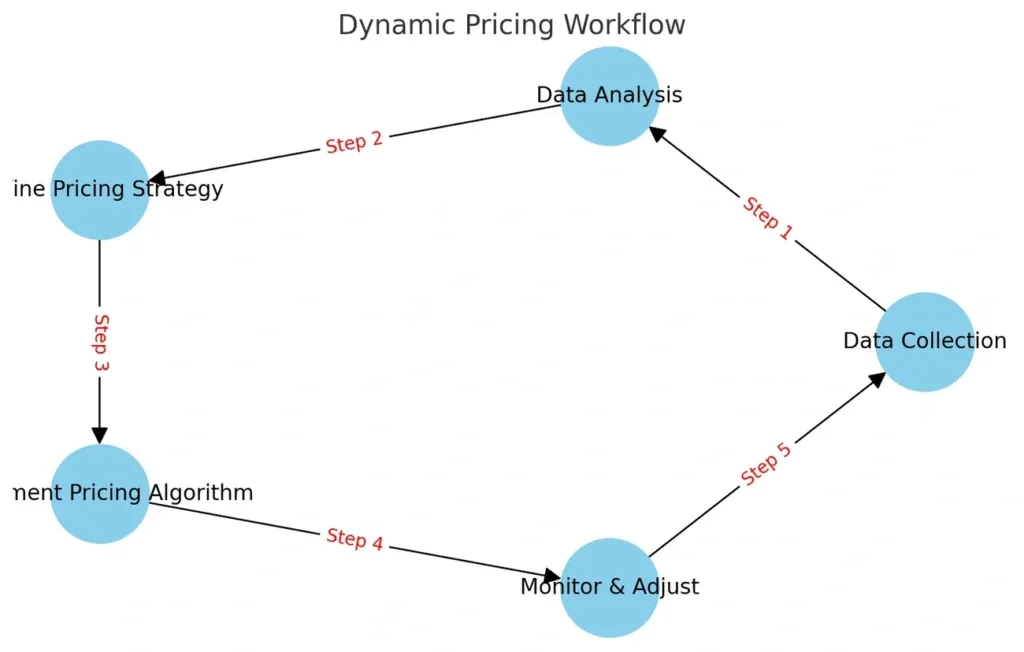
Image Source: Nected.ai
Modern elasticity models give businesses clear advantages that show up in their bottom line. Companies that use these new approaches see their revenue grow and operations improve.
Dynamic Pricing in Ride-Sharing Platforms
Ride-hailing platforms like Uber have changed transportation in part through smart price elasticity modeling. Their surge pricing system uses huge amounts of data to work out elasticities right away and adjust prices to match supply with demand. The system has revealed some eye-opening patterns about behavior. A price bump from 1.0x to 1.2x surge makes demand fall by 27%, which points to a price elasticity of demand (PED) of 1.35. Something even more striking happens when surge goes from 1.9x to 2.0x - demand drops six times more than between 1.8x and 1.9x just because customers see 2.0x as “viscerally larger”.
Take our free profit pulse audit to assess your current pricing strategy and what it means for your business.
Personalized Pricing in E-commerce
Big e-commerce players now use elasticity-based customized pricing more and more. Amazon runs dynamic pricing tests that change prices based on detailed customer data. Tesco uses its loyalty program the same way to gather customer information and offer custom prices. Retailers can capture more consumer surplus and grow their market share this way. A newer study, published by Carnegie Mellon shows customized ranking systems might accidentally push AI pricing algorithms to charge higher prices.
Case Study: CPG Brand’s AI-Powered Elasticity Tool
A major consumer packaged goods company changed its pricing strategy through AI-powered elasticity modeling. The new system automated what used to be manual calculations and created interactive simulations to test different pricing scenarios. Teams could see right away how price changes would affect key metrics like sales volume, gross sales value, and profit. The dashboard became their core tool for pricing strategies in four global markets, with plans to expand to more regions.
Conclusion
Simple economic models can’t keep up with today’s complex marketplace. The basic rules from Economics 101 no longer explain how prices and customer behavior are connected. Your current elasticity model might be hurting your pricing strategy. Let’s look at why this happens and how better approaches can give you an edge.
ML technology offers game-changing alternatives to old methods. Gradient boosting spots complex seasonal patterns easily. Neural networks help optimize prices better than ever before. Double machine learning helps solve the problems of finding true cause-and-effect relationships. Companies using these advanced modeling techniques have seen their margins grow 2-7% in just one year.
Good data is the foundation of accurate elasticity modeling. Your models need complete sales records, detailed price history, market context, and clean data. Even the smartest algorithms will give you bad results without proper data preparation. Bad data leads to pricing strategies that hurt your bottom line.
Looking at specific segments gives you more control over pricing. Customer groups, channels, and SKUs all react differently to price changes. Old models miss these subtle differences. Understanding these patterns helps you get the most value from your business segments.
Real-life applications show how modern elasticity modeling revolutionizes business. Ride-sharing companies adjust prices on the fly. E-commerce giants personalize prices for each customer. These methods work - just look at the CPG case study. It shows how AI-powered tools can calculate elasticity automatically and help plan different scenarios.
The year 2025 is approaching fast. Your pricing strategy needs to grow beyond simple elasticity assumptions. Old, static models hurt profits in markets where consumer behavior changes faster than ever. Making use of AI-enhanced elasticity modeling isn’t just about staying competitive - it’s essential to build a business that lasts.