
Testing Launch Prices Before Going Live
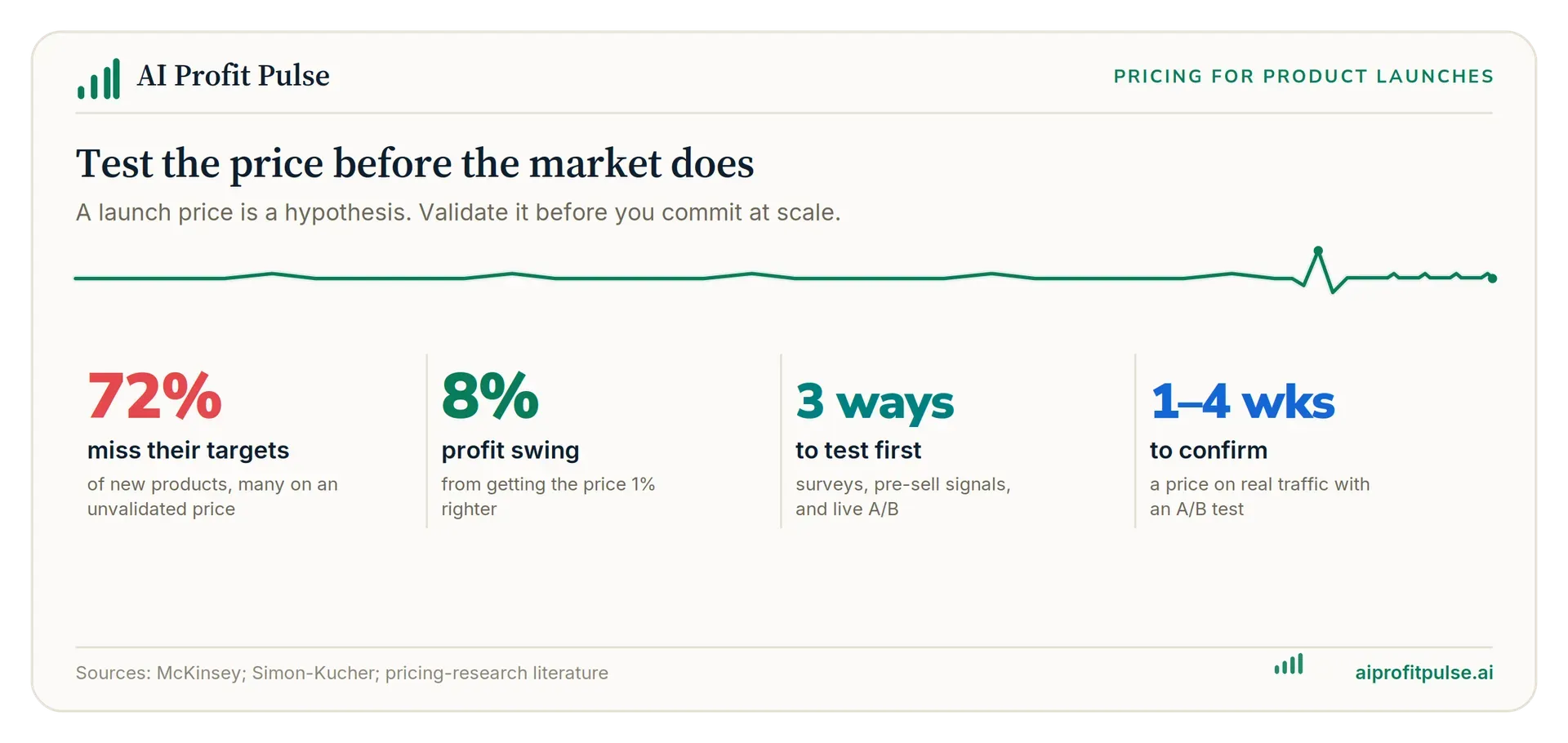
Most teams set a launch price the way they pick a meeting time: someone suggests a number, no one strongly objects, and it ships. Then it becomes the anchor customers remember and the ceiling your revenue lives under. That is a lot of weight for a guess. Simon-Kucher’s research found that 72 percent of new products miss their targets, and an unvalidated price is one of the most fixable reasons why.
The fix is not a better guess. It is a test. Treat your launch price as a hypothesis and validate it before you commit, and you turn the single riskiest number in the launch into a decision backed by evidence. If you want to know where your current pricing is already leaking margin, start with the Pricing Pulse Audit, a short, evidence-based read on your pricing strategy.
Why is the launch price worth testing at all?
Because the leverage is enormous and the downside is permanent.
Pricing is the fastest profit lever you have. McKinsey’s analysis of the S&P 1500 found that a 1 percent improvement in price lifts operating profit by roughly 8 percent when volume holds. On a launch, you are not adjusting an existing price by a point, you are setting the anchor from scratch. Get it a little wrong and you either leave money on the table for the life of the product or price yourself out of adoption before word of mouth can start.
There is a counterintuitive finding worth sitting with: higher prices often convert better, not worse, because a serious price filters for committed buyers and signals quality. You cannot know where that line sits for your offer without testing it. Guessing low to “be safe” is frequently the expensive mistake.
What can you actually test before launch?
You have more options than a coin flip, and they range from cheap and fast to slow and definitive. The mistake is skipping the cheap ones, or trusting them as if they were the definitive one. Willingness to pay is a range, not a single number, so combine methods rather than betting on one.
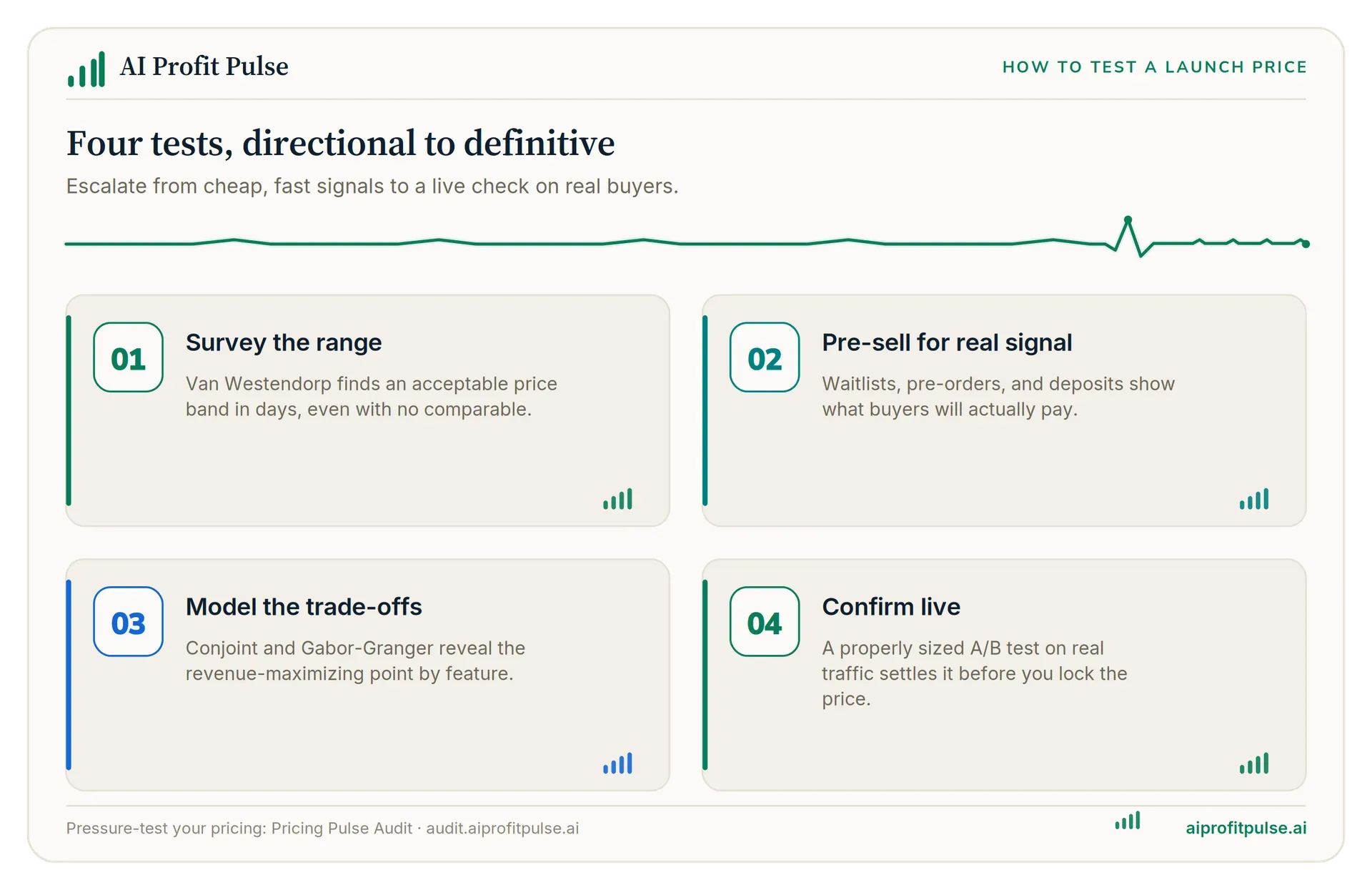
Survey the range. When you have no direct comparable, a Van Westendorp price-sensitivity survey gives you an acceptable price band in one to three days by asking buyers what feels too cheap, cheap, expensive, and too expensive. It is directional, not definitive, but it stops you from anchoring on a number pulled from the air.
Pre-sell for real signal. Nothing beats money. Waitlists, pre-orders, deposits, and paid early access are the strongest willingness-to-pay evidence you can get before a full launch, because they cost the buyer something real. If people pay upfront at your intended price, you have validated the price and the demand at once.
Model the trade-offs. When you need one specific number, Gabor-Granger testing points to the revenue-maximizing price, and conjoint analysis shows how buyers weigh features against price so you can set tiers with intent. This is also where our guide to the hidden math of willingness-to-pay analysis earns its keep.
Confirm live. Before you lock the price for good, a properly sized A/B test on real traffic shows actual conversion and revenue at each price, usually within one to four weeks depending on volume. This is the definitive check, and it is the step most teams skip. Our playbook on how to run pricing experiments without killing your revenue walks through doing it safely.
Where price tests go wrong
Three mistakes turn a good test into a misleading one.
Asking in isolation. Direct survey methods let people over- or understate what they would really pay. Treat stated preferences as directional and confirm with behavior wherever you can.
Testing one number instead of a range. A single price point tells you how that price performed, not whether a better one exists nearby. Test a spread.
Running underpowered A/B tests. Too little traffic produces a confident-looking result that is really noise. If you cannot power a clean test yet, lean on pre-sell signals and surveys rather than a false read. Our breakdown of A/B testing mistakes that quietly cost revenue covers the traps in detail.
The takeaway
Your launch price carries more weight than any other number in the launch, and it is the one most often set by guesswork. You do not have to. Survey the range, pre-sell for real signal, model the trade-offs, and confirm live before you commit. Given that a 1 percent price difference is worth roughly 8 percent in profit, a few weeks of testing is the highest-return work you can do before going live.
Want to see where your pricing is leaking margin right now? Take the Pricing Pulse Audit. It is short, evidence-based, and built to show you the gaps worth testing first.